PIECESISSUESMASTHEADJOIN & SUBMIT
2 / 13

Trends: A Sole Collection

Lucy Kaplan, Juliet Corwin, Riley Stevenson, Elsa Eastwood, Ava Satterthwaite, Annabelle Stableford, and Anika Weling
February 12, 2026

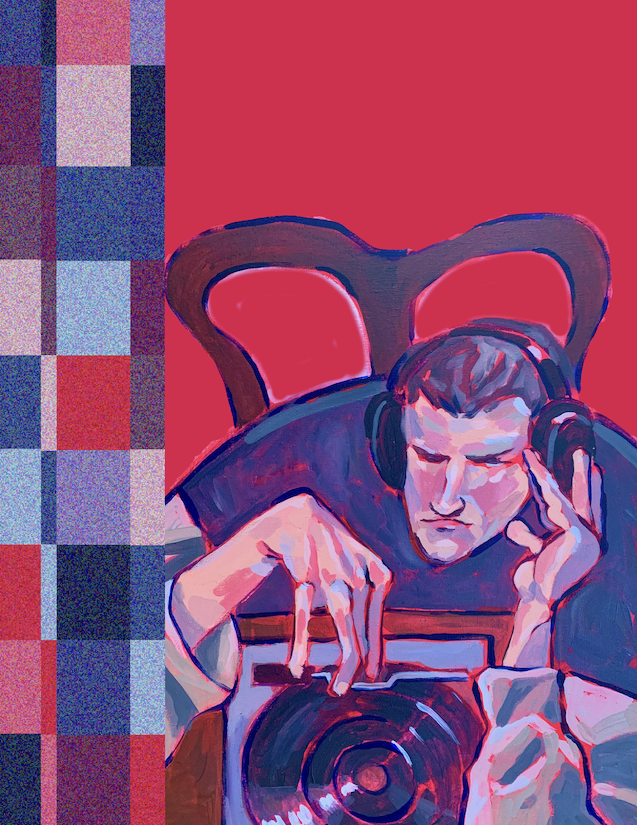
In my youth, a jar of pickled herring claimed the back right corner of the fridge. I can’t quite point to my father’s Jewish ancestry as the reason; it seemed more of a personality quirk that compelled him to crave tangy fish on a seeded cracker before his three o’clock nap. My brother and I followed suit, curious eaters tempted by scores of gefilte fish and gravlax at break fast, Passover, and the occasionally attended Saturday service. On weekends, we grabbed bagels with whitefish from Lenny’s, a half-decent deli we remained loyal to for the name it shared with our late grandfather. Not the finest in the city, but every New Yorker knows that the best sandwich comes from the place around the corner. After our westward relocation, my appetite persisted. No longer able to race down the stairs and across the street to satisfy my hankerings, I stacked the cupboards with tinned fish of my own choosing. Smoked sardines in olive oil, thinly filleted mackerel, salmon preserved with lemon—a hazy ode to New York winters gone by. Salt and sour clung to the walls of our kitchen, reminiscent of the mom-andSole ME copy 25 copy (3).inddc 14 trendy to forget to eat. Somewhere around fifth grade, I think. pop shops we once frequented. This one, our own. When I left home, I folded my f ixation into my suitcase—not a trend, but a history. I etched a pair of salmon onto my upper thigh, drawn with a dark ink that felt like blood. A finelined reminder of Passover and Grandpa Lenny and my father’s pickled herring. Last month, I remember in health class, how my teacher told us about thigh gaps and how to check if we had them. After class, a group of us stood in a circle, touched our ankles together, and prayed for emptiness. We’d skip meals and then skip SILENT HUNGER WAS THE LANGUAGE OF THE STRONG. “ ” JU LIET CORWIN I stopped dead in my tracks at a familiar crosswalk in New York. There it was: the closure sign in Lenny’s window, dated two years prior and peeling at the edges. My stomach roiled as the word imposter came to my lips. I was sulking in a city that held my past and escaped my future. That same week, my father sent me a pair of winter boots, a tin of smoked f ish stuffed inside the left footbed. Somehow, he knew I was mourning. Sweet Girls By Juliet Corwin I try to remember when it became 14 rope during recess. When we got lightheaded during P.E., we’d lie and say we had cramps. (Most of us hadn’t started our periods yet.) When our bellies grumbled in class, we’d pretend not to hear it. We’d look at magazines of flat stomachs in low-rise jeans and poke at our pudge. We bragged about how long we could go without eating. We’d sneak chips and cookies when the others weren’t looking and hope the crumbs didn’t leave a trail. To eat was to be weak. We couldn’t give in to the gnawing. Silent hunger was the language of the strong. It became honorable to ache for food, a rite of passage into the womanhood we so desperately awaited. 11/26/25 4:46 PMAnd nothing could taste as good as skinny felt, right? I remember the shame that blushed at my cheeks after I caved and ate the pasta and chicken that my mother had lovingly cooked for me. On-Campus Observations From An Off-Campus Oyster Farmer By Riley Stevenson To be on a college campus is to be surrounded by trends. Spend fifteen minutes on the Main Green and you’ll see a dozen micro-trends, some here to stay and most bound to disappear into the backs of closets; new accessories worn in creative ways over ever-lowerslung jeans held up by a kaleidoscope “ HIS WORLD IS ONE OF SALT, FROST, AND FIREWOOD, OF WEARING THE SAME MUDCAKED SWEATSHIRTS TO WORK AND SEEING THE SAME FLEECECLAD OLD PEOLE IN OUR SMALL MAINE HOMETOWN. RILEY STEVENSON of belts all turning to dust. My boyfriend is an oyster farmer from a small town in Maine. His world is one of salt, frost, and firewood, of wearing the same mud-caked sweatshirts to work and seeing the same fleece-clad old people in our small Maine hometown–a life without much room for personal expression through trendy clothes. Observing the trends of our campus is his favorite activity when he comes to visit. He walks into the Blue Room, sympathetic to all of the college students hunched over their laptops, buys a coffee, and sits on the terrace overlooking the Green, noticing. As a freelance journalist and astute business landscape rendered big bands unviable. It died again in the 60s, when bebop became esoteric and cerebral, a “musicians’ music”. Young people wanted to rock instead of think. It went out with the Old Guard—with observer of the human condition, he is uniquely primed to note and catalogue, dedicated to his craft of perceiving what has changed since he last stepped foot on both this and his own college campuses. After I am done with class “ he barrages me with questions and commentary about what he’s noticed, like an off-duty WE MAY TALK OVER IT AT COCKTAIL PARTIES, LET IT WAFT OVER OUR HEADS IN ELEVATORS, BECAUSE WE, LIKE THE YOUTH OF THE 60s, HAVE ENOUGH TO THINK ABOUT. WITH MUSIC, WE SCROLL AND SKIM SURFACES. anthropologist, notebook in hand. He is excited, irascible, brimming with observations, seeking confirmation, ever-excited by his day’s work.“Does anyone here use a backpack anymore? Could the jeans get any baggier? Do you think anyone wants to buy my pre-paint stained Carhartts?” I shake my head at him and laugh, knowing the questions are the fun part, their ” answers irrelevant. We walk through the Green hand in hand as he tells me about his findings. I marvel at the ELSA EASTWOOD ” Armstrong and Ellington, Billie, Dizzy, and Dexter—and again with Bird, Monk and Miles, with Wayne and Coltrane. They say we’ve succumbed to the musical Big Mac of commercial pop, and not even Wynton Marsalis can bring us back. I believed them. Then last year, I won a ticket through an Arts Institute lottery to see Jon Batiste in concert. I never win anything on that website. I knew him only as the bandleader on The Late Show, but I had to go. Arriving at the venue just before 7pm on a Thursday, I stepped past a nauseatingly long standby line of fans clutching setlists and trading deep-cut references with fervor. I recognized some from my music theory courses and offered a few guilty waves over worlds we occupy, the observations that allow us to see how others see their world, how lucky I am to share this world with someone as thoughtful and observant as he is. Jazz is Dead By Elsa Eastwood They say jazz is dead. It died first after World War II, when a changing 15 my shoulder as a woman scanned my ticket. I chose a seat in the very front, just beneath the grand piano—the piano on which my jazz hero would perform a reharmonized “Star Spangled Banner” unlike anything I’d heard. His expansive fingers stretched across the keys like vines, entwining gospelinflected voicings with modal color, face contorting in testimony. His was a music of lineage and remembering, pain and power, the improvisatory human experience; a music that traverses valleys and wades through Sole ME copy 25 copy (3).inddc 15 11/26/25 4:46 PM“That’s the trend, Mom.” rivers, moving through space and psyche. It was sacred and lyrical, percussive and raw. Creation and truth-telling unfolding in real time. The arrangement lasted 15 minutes. Standing with the crowd, hand to heart, I soon shook with tangled sobs of peace, joy, and heartbreak at what felt like the most perfect convergence of sound and history. The old and patriotic, broken open in one trembling instant. I say jazz is alive. It’s adapting to a changed landscape, vivified by its own endurance, shedding its skin in the dark. It emerges between genres like a ghost in the machine. We may talk over it at cocktail parties, let it waft over our heads in elevators, because we, like the youth of the 60s, have enough to think about. With music, we scroll and skim surfaces. But if allowed, it will instruct. It will wait for us to remember how to listen. It will continue to send messengers to remind us that, bruised but dignified, it still pulses beneath the noise. The Chronicles of the Traveling Pants By Ava Satterthwaite The first time I asked to borrow my mother’s bell-bottoms, her face “ STILL, IN THOSE BELL-BOTTOMS LIVE FIELDS OF HER ROSE AND LAVENDER FRAGRANCE, DENIM THREADS INTERWIEVING LIKE STRANDS OF HAIR SHE’D DUTCH BRAID BEFORE BED. AVA SATTERTHWAITE scrunched in disbelief. “That’s the trend now?” she asked, befuddled. I never wear them, of course – the tide of the trend shifted long ago. Still, in those bell-bottoms live fields of her rose and lavender fragrance, denim threads interweaving like strands of hair she’d dutch-braid before bed, silhouettes of her twirling between twill ruffles like we’d dance in the kitchen to “Better Than Revenge” and “Fearless.” All around me are reminders of adolescence. Pink bow UGGs mellow into classic tans. Black puffer vests I followed her to the attic, where we coiled between stacks of doodle-laced notebooks, faded letterman jackets, and clusters of swollen crates— one labeled CHRISTMAS DECOR, another RECORDS + CDs, a third DENIM. It was like Narnia – an entire world of memories hidden behind her wardrobe. She found the bell-bottoms under a mound of distressed overalls and low-rises and threw them over her shoulder. Snickering, she asked if I’d like a flower headband or some fringe boots to finalize the look. But, as I stood in the mirror, smoothing the creased flares and fiddling with the waistband, a tear skimmed down her cheek. “That’s the trend?” she echoed, voice faltering. I nodded. “It’s just like I remembered.” ” When I came to college, my mother snuck those bell-bottoms into my suitcase as a farewell, her scribbled note stuffed between its folds. Call Your Mom! it insisted – like I’d need the reminder. Frankly, the further I wander from home – from childhood – the more striking our resemblance becomes. I listen to “Landslide” with such reverence it feels biblical. I add crushed Kellogg to my cookies “for some crunch” and dark chocolate chunks “for the bite” like she advised. I drink iced Sauvignon Blanc and shake my leg so excessively the whole table wobbles, its steady thrum reminiscent of our once shared dinner table. I never considered my s e l f sentimental until I rediscovered her bell-bottoms looming in the recesses of my dorm-issued wardrobe. 16 overtake matted lime-colored North Faces. Like my mother, I’ve been fossilized over and over, my fleeting memories buried beneath old boxes and new clothing, my own forsaken Narnia. The trends, timeless and teenage-dirtbagish alike, fill these archives with precious evidence of our evolution. I grab the bell-bottoms and look toward a clouded mirror. I’m much older now: cheekbones more defined, brows furrowed tensely. The denim is stiffer now, too. It holds me a little tighter, and I think warmly of my mother’s arms. It’s just like I remembered. Merriam-Webster By Annabelle Stableford trend noun a : a line of development : approach b : a current style or preference : vogue c : a general movement : swing d : a prevailing tendency or inclination : drift Approach: To identify three intrigues: two trends of my life, and for fun, a not so subtle trend that consumes me, which you may discover hidden throughout this text (although I am no mastermind). Vogue: So it goes, it is not in vogue Sole ME copy 25 copy (3).inddc 16 11/26/25 4:46 PMbe in vogue, nor am I in vogue. But I persist. Swing: According to my memory, everything that ever happened to me happened when I was eight. There were troubled nights and tears culminating in the visit to the energy healer, who proclaimed me a blind farmgirl in a previous life (that escapes me as well a pendulum now, coming back in crisis to explain everything). And the drunk man at the natural hot springs and the woman who told me to look away, to imagine his image washing away in the river (except “ Quarantine Trends By Anika Weling It’s sad to think of what I will say when my children ask me what I did during the COVID-19 pandemic, the most prominent event of our generation. I wish I could say I did anything useful. I could lie and say I helped save lives or protect rights, but in reality I sat in bed for months on end, fixated on a little LED screen I REFUSE TO FORGET MY LIFE: THE SHARPNESS OF WORDS, THE KIND THAT ONCE YOU READ THEM, THEY HARBOR WITHIN YOU. eight inches from my face. I listened to the distant hum of the news from my living room, an ominous loop of ANNABELLE STABLEFORD every time I try, the current reverses). And when I read Tuck Everlasting and in the story discovered a profound magic all for myself (novels, within my realm of independent reading now!). Ex. “You have a favorite spot on the swing set / you have no room in your dreams for regret.” 1 Drift: “Pulled him in tighter each time he was drifting away.” I refuse to forget my life: the sharpness of words, the kind that once you read them harbor within you; the ten hardboiled eggs I watch someone eat at breakfast, all in one go (perhaps not profound, but noteworthy); the things that happened to me when I was eight and in all the eras after. All of this goes into my Volumes, my Immortal Histories, my Moleskines (2019-2024) and Leuchtturms (2024-present), my most critical trends. I don’t let any of it drift away. Ex. “Pulled him in tighter each time he was drifting away.” 1 ” muffled, monotonous voices with nothing good to say, so I hid under my covers. I watched video after video on how to make dalgona coffee, while hating coffee, and how to 1 Attribution of quotes (spoiler warning): Taylor Swift do Tiktok dances, which I had no desire to ever learn. I saved DIYs and recipes to a folder, only to never look at them again. Propped up in bed, I took online classes while the world fell apart around me. The numbers rhythmically continued to climb. One million. Two million. Ten million. No one ever taught us what to do in the case of a pandemic. No one thought we would need to know. So in the utter chaos around us, we turned to distraction to survive, to escape. Never-ending entertainment f lashed passed us as we chased a relief we could never quite reach. We fell into rabbit holes where we never had to stop and realize what our lives had become. It’s trend, after trend, after trend. Around me, everything is still, everything is quiet.
Casio's Avocado

Miya X Wu
February 12, 2026

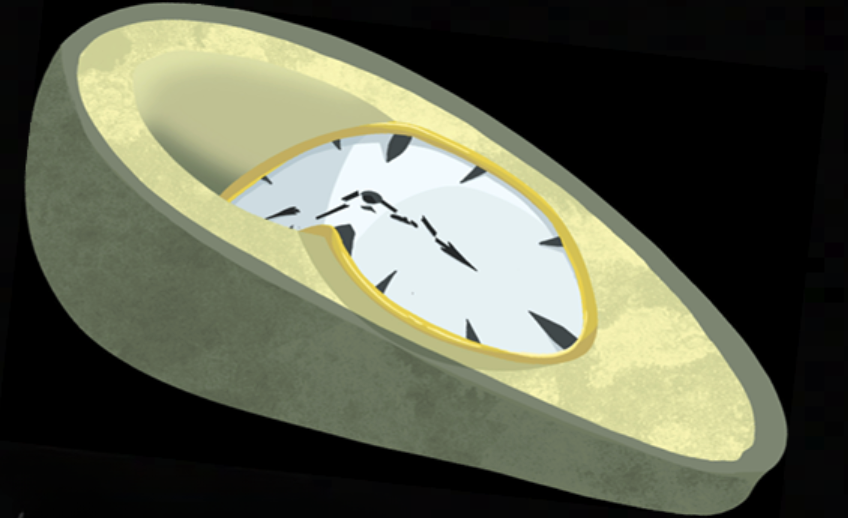
Suppose you exit the parking structure at Westfield UTC in San Diego and walk towards the open-air atrocity, filled with more options for oatmilk matcha lattes than are good for your sanity. In that case, the first thing you will see is one of the two Lululemon locations in the mall (really?). Ignore it, turn right. Not far away, a pink circular sign waves from the wall, the silhouette of a man in a newsboy cap looming over a cup of coffee, offering “Joe & The Juice.” The interior of the shop is on the darker side, a similar atmosphere to that millennial-run burger joint that serves its overpriced truffle fries on fake newspapers. The menu offers smoothies and juices whose names give you not a single hint of what you are ordering, except maybe the color of the beverage. This leaves the cashiers entertained as the queue of squinting customers try to read the ingredients in tiny print under names like “Iron Man” and “Prince of Green,” their eyes occasionally widening at the right side of the menu. On the walls are framed quirky posters like “I just saved some wine, it was trapped in a bottle” and “more espresso, less depresso.” One of the many posters humorously comments on the human encounter with avocados: “too soon… too soon… too soon… NOW too late…”, referring to the universal pain of finding your morning avocado, which you’ve been looking forward to all night, disturbingly squishy—even though you could’ve sworn attempting to cut it yesterday afternoon almost chipped the knife. On my left wrist, there is a permanent white band, a mark left by the joint effort of the sun and my Casio Baby-G that mom got me when I turned twelve. Its watch band is now off-white from the five years of weathering, with faint, darker spots on it from that one time I helped my mom dye her grey streaks black. That avocado on the poster from Joe & The Juice seems to have gotten itself a little too acquainted with my watch. Every tick of a handle, every tock of the gears, seems to smear that damned fruit into every uncleanable crevice of the machine. The rose gold watch face and its hidden surfaces are painted with a filthy green explosion of nostalgia, filling every unoccupied moment with the remnants of something that used to promise a great avocado toast. So unruly this fruit that its colors seem to bleed onto nostalgia itself, contaminating it with its bad habit of causing untimeliness. Nostalgia is the only word a writer can really put on it. The persistent state of “missing.” The endless cycle of living in the past and the future, but somehow never the present. You look forward to something about to happen, forgetting to look at the ground at your feet. You pick up an avocado hoping to make guacamole, only to find it hard as a rock with anticipation for tomorrow’s day, not quite fit for making guac, so you leave it in the fridge. That same afternoon, you return to it with the new idea of slicing it and putting it on toast, only to find it has become too mushy to be sliced, so you leave it on the counter. The next day, you return to it to finally cut it open, and find that it is too mushy for anything at all, with dark spots crawling on the light green flesh. So then perhaps the mythical “prime” of this devilish fruit doesn’t exist, the “present” an elusive thing before it becomes nostalgia. I want a perpetually solid avocado to fulfill all of my slicing needs, and another forever mushy one for on-demand guacamole. I know I can’t have that. They haven’t even made GMO avocados that do that yet. So what then? So what if you’re looking forward to something that’s yet to happen? Something is happening right now for you to miss later. So what if I lost my watch the first month of my freshman year in college? Its reliable mechanics have gotten me this far, and I have nothing but good memories and a sweet few chapters of my story with its rosy reflection glimmering on it. So what if something has already happened and you feel sickening butterflies upon its absence? At least you once had something beautiful enough to cause this colorful affliction. So what if my guacamole is a little chunky because the fruit was unripe? So what if my order of avocado toast is a little mushy because the fruit was too ripe? Before it gets rotten and you have to trash it six feet under, eat your avocados.

A Table of Our Own

Lucy Kaplan
November 12, 2025

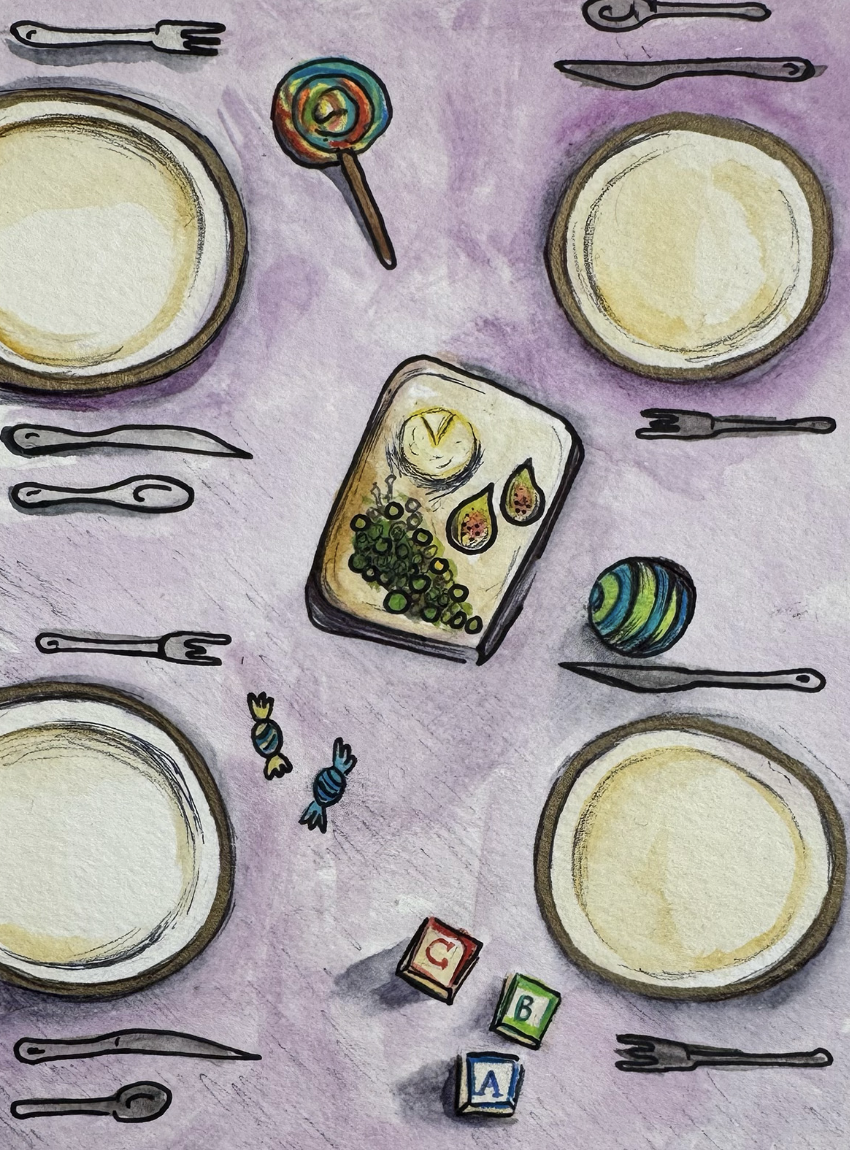
A Table of Our Own I arrange tea candles on the tablecloth, makeshift and patterned by stains that bleed into the florals. A relic of our parents’ generation, the textile is only thick enough to disguise the aged wood it envelopes when folded twice over itself. Tonight, it bares the weight of the six hours I spent cooking. We have first une salade niçoise served with lightly candied brussel sprouts. A crested hill of layered caprese follows, sliced baguette flowering its perimeter. Guests arrive in waves. Three are early and two are insultingly late, forgiven for the gossip they bring to the table. She told me he didn’t even wave when he saw her the morning after. Friends present gifts of crisp grapes, whimsical confections, bottles they pray aren’t too sweet. As we find our seats, I wonder: is this the dinner party of our parents’ generation or a reincarnation of our childhood birthday celebrations? It seems to me as if every young adult loves a dinner party. A gathering classy enough to warrant dressing with inspiration, but intimate enough to speak without reservation. Maybe it’s the breaking of bread, a practice reportedly powerful enough to have united the Democrats and the Federalists, the Wampanoag and the colonists. But just as those narratives are not simple truths, neither is the elation of our careful gatherings. Dining together can be as unpleasant as it is festive. Generations of meals have been the source of unassailable tension: reunions made unpalatable by parental bickering and younger brothers smacking their gravy-smeared lips. In attendance are the people we love—though perhaps do not always like. Our dinner parties, however, are distinct in their autonomy of choice. In childhood, parents managed the grunt work, pitching fairy-lit tents in the living room, ordering pizza to satiate the crowd. Now, we find ourselves left to our own devices. We create countless lists in the name of adulthood. Dinner 07.13 Invite list: Yeses, nos, maybe-sos. A back-up list if someone falls through; empty chairs thrill no one. Invitation draft: Dearest friends, you have been chosen. Dress appropriately. Menu: Parmesan crisped yams, miso butter gnocchi, flank steak. Made to impress. Shopping list: Chicory root, sardines, brie. The cheapest available. Setting the table, I think about generations past. Decades prior, someone else a few years older must have stood in this kitchen—a local career politician or an established dermatologist. He too was expecting visitors, but with not nearly as much anticipation. He knew the procedure by rote—when to serve the second course, when to slyly refill his neighbor’s wine glass. He could identify a false laugh and ease a lapse in conversation without skipping a beat. The guests were familiar, practiced in leaving their shoes at the front door. I can almost place my childhood self into the scene: sunken into the corner chair, across from the man in the ugly scarf. Last time I saw you, I could have fit you in my briefcase! Why do middle-aged academics delight in making middle-schoolers feel small? Our guests are poles apart, far closer in affect to the children our parents once invited to summer movie nights on our behalf. They stumble at the formalities. Someone might forego the formal dress code for a sloppy pair of basketball shorts; we will say nothing but stare as he meticulously covers his lap with a napkin. Dock one point. Someone else might bring a new boyfriend with no notice; we will feign placidity as he pulls an extra seat between a pair of best friends longing to catch up. Dock two points, maybe even three. But what we lack in finesse we make up for in forgiveness. Friendship is a delicate thing—we know some faux pas are best granted a silent pardon. Warm light washes down our nerves as the feast begins. Some go all-in, stacking their plates with mismatched goodies brought by unpracticed guests. (Was this supposed to be a potluck? No one quite got the story straight.) Others graze, arms extending clumsily across the table to pluck an olive, a “pardon my reach” carefully uttered. We take an unspoken pride in our maturity, remembering our pleases and thank-yous so far from the oversight of our elders. The night then goes one of two ways. The clinking of cutlery might crescendo at half-past nine. Replacing it will be an awkwardness which we bear with guilt. If the spark of enlightened conversation never catches fire, we are left with a table full of friends-turned-family-turned-strangers. We might have worn the badges we found in our parents’ closets with too much assurance. Cause of death: an indulgence of formality and poverty of wine. One can only pretend that they don’t want to talk about sex for so long. Tonight, however, we evade a tragedy of the commons. The now unlit candles go unnoticed, puttering out one after the other; as the tablecloth dims, our momentum only swells. Half of the crowd is debating the merits of Machiavelli, the other half the audacity of a kid we knew from high school. The catch is, it doesn’t really matter. Everyone is full and no one wants to leave. Someone reveals an expensively curated box of chocolates from a rumpled tote they had carefully hidden beneath the table. We pass it counterclockwise, excitedly snagging the sweet recommended by the person before. I bite down and my mouth bursts with nostalgia. A buttery shortbread, laced with silky caramel and enrobed in milk chocolate—a Twix bar by another name. I watch my friends bite into rebranded versions of their own childhood favorites: Snickers, Milky Way, Almond Joy. Are they too thinking about Halloweens past? How we zealously provoked territorial disputes over the mounds of sweets poured onto my living room floor. It feels no different than how we tonight bicker over who deserves the final drops from the bottle. Across the table sits the girl who watched me blow out purple candles on my eleventh birthday. She wore different glasses back then, thicker frames that obscured the brilliant eyes that now lock with mine. I watch her fingers toy with the stem of a glass as she chews her grown-up Kit Kat. To love her is to peer through a foggy window. If I squint, I can piece together the blurry outlines of our past: the pizza parties, the Halloween spats, the movie nights we spent wrapped in blankets on the porch. Then a new image clears—decades of future soirees coming into view. I am elated to see that the future unfolds not at our parents’ tables, but around a table of our own.

Zia Felicetta: A Portrait

Luca Raffa
November 12, 2025

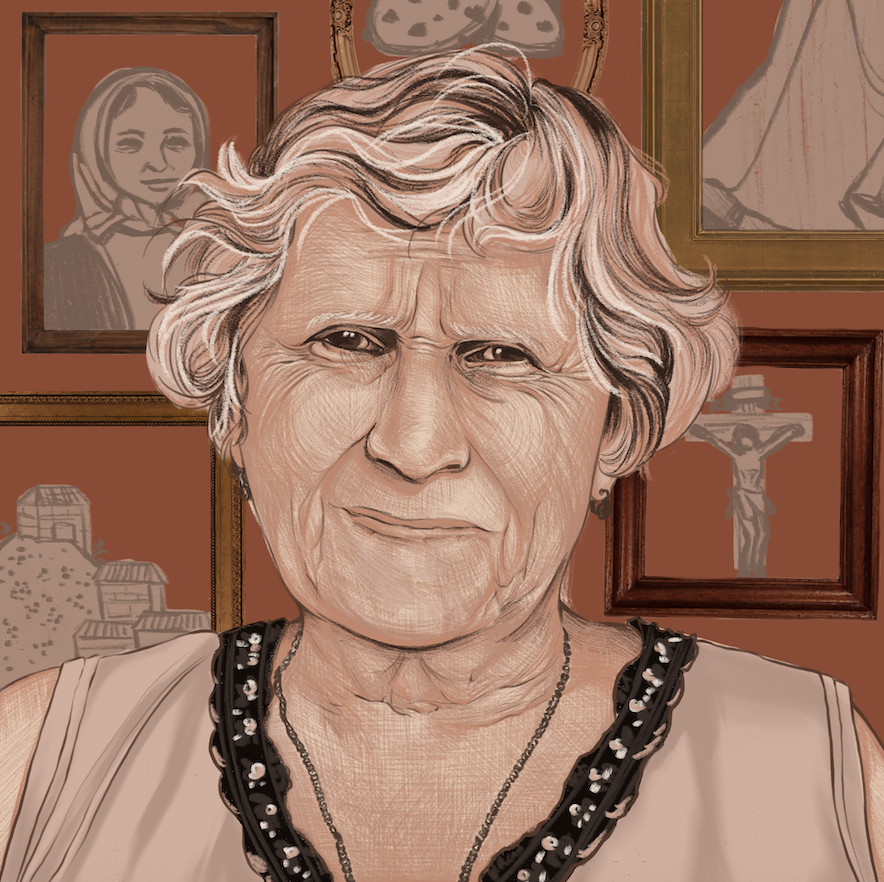
I parked in her empty driveway and approached the proud house with stubborn orange bricks. The black railing guiding me to the door ailed with rust, though the white paint on the house was fresh as the snow. It was dim, the sun obscured in this dull December sadness, and the icy lake winds caused the lampposts to shiver with doubt. I rang the little doorbell and peered around. The short bungalows huddled close together to keep warm from the snow. Darkness was beginning to blanket the neighborhood. Suddenly, a faint light flickered on from inside. I peeked through the doorframe glass with a smile and watched as a figure hurried towards me. The door opened. Zia Felicetta greeted me with a tender hug and the touch of her delicate cheeks on each of mine. Her demeanor was elusive, her faint smile always uncertain below her serious eyes––sad, dry eyes which caved into her head and cast shadows. The wrinkles on her cheeks and on her forehead revealed the scars of time, though her small diamond earrings restored some dormant youth still hiding within her. Black strands like needles freckled the white hay that crowned her head. Zia waddled towards the kitchen, and her plump body disappeared into the dark. A nativity scene of plastic figurines emerged in the corner. Zia had been a widow for over forty years and was the last and only surviving of five loving sisters and their husbands. Across the walls, these ghosts gawked at me, black and white, through the frames: Zia’s husband holding her tight in her wedding dress; her sisters––Carmella, Roquina, Peppinella, and Maria, my grandmother––through the years at her wedding, and at their weddings, and at their children’s weddings; her nephews and nieces who died as infants; the only surviving photograph of her mother Vittoria, the woman she watched die as an infant, wearing a dirt-caked shirt, a shoddy headscarf, and a faint smile; her father as a young man with a black coppola hat and a black mustache; and the same man with a bushy grey mustache and slicked back hair. Hovering higher on the walls were images of saints, Gesù, crucifixes, and a collection of memoriam cards she gathered over years from funerals. She even framed a photograph of Montoleone di Puglia, the town she left behind: a cluster of orange shingles, brown bricks, and white concrete sleeping on a hill and surrounded by green planes and wildflowers. Zia returned holding a ready plate of cookies wrapped in tinfoil, the wrinkly fat drooping from her arms from the weight of the plate. She invited me to sit at the table and offered me an espresso which I knew I could never refuse. She vanished again into the kitchen, and in the silence of her home I could hear the clanking as she fed the cafetera the espresso grinds and placed it on the stove. When she returned to the dining room table, she unwrapped the cold cookies. She enjoyed making food and freezing it for an infrequent visitor. She put a hard candy into her mouth that reeked of licorice, anise, and fennel and began to suck. The hot espresso breathed life into us and kindled conversation. She was simple, of little words, knowing only how to talk about her food, her family, her garden, or God. She had no preferences, few opinions. She paused a lot and would watch me. She was a patient woman, watching intently and listening as I sipped on my bitter espresso. When she began to speak, the movement of her firm jaw and soft lips came together in a symphony of schwas. Soon, it was time for me to depart and return Zia to her solitude. Her frail pleas asking me to stay surrendered to my guilty resoluteness, and she disappeared into the basement for one last parting gift. As I waited for her before the door, I glanced at the frames on the wall again. I started to wonder if Zia ever talked to these ghosts––after all, she was a spiritual woman. Zia emerged from the staircase and brought me more cookies in tinfoil and a panettone to remember her by. She embraced me and kissed each cheek, speaking to me I love you in her unsteady English. I said goodbye. She waited alone in the frame of the door. The cold followed her inside. I thought about how she might become a photograph someday, and my heart sank.

A Few Impressions

Juliet Corwin
November 6, 2025

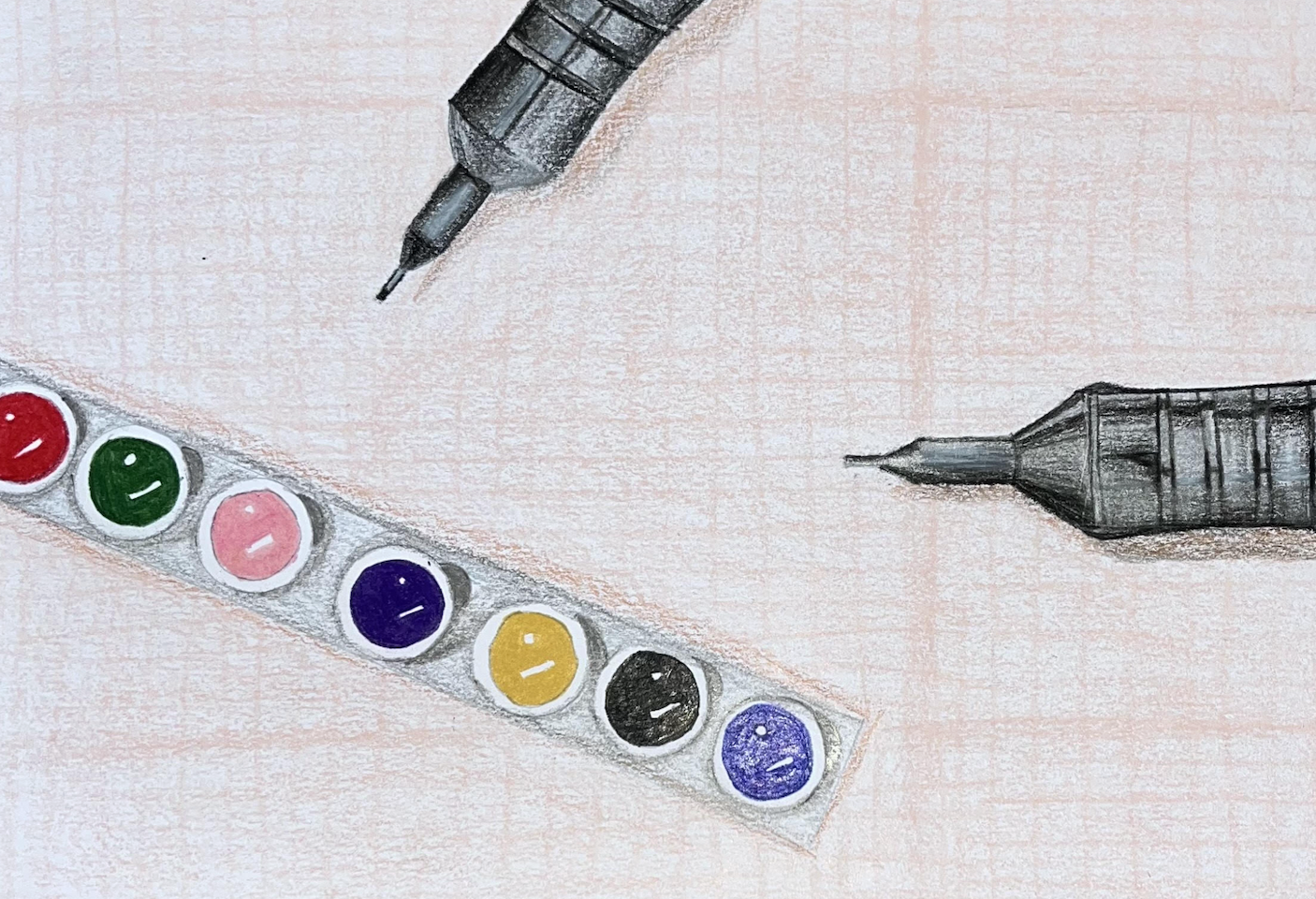
– CT, left wrist – I drove to Connecticut to get my first tattoo. The studio, smaller than its parking lot, was tucked away in a gray fold of Stamford. It had been a drizzly morning, and clouds sighed as I walked to the entrance. Timidly, I leaned against the door so it wouldn’t slam shut and scanned the space for a pair of eyes to meet mine. It was my first time inside a tattoo studio, and it showed. Two feet in front of me, a woman lay on her side in a shirt, underwear, and Doc Martens. She chatted with her artist, who hunched over a spread of ink covering the woman’s thigh. The walls were covered in overlapping sketches and prints. Sitting by the only other station in the room was a large man with a permanent frown and huge biceps. I gathered that he would be my artist, and moved toward him. His frown deepened when he saw me. He spoke in short sentences, his voice low and quiet. I showed him the tattoo I wanted and presented my wrist to draw on. Opting for a purple marker, he splashed the design onto my skin way too big. I asked if he could make it any smaller. His eyebrows lifted, but he rubbed away the first drawing and drew it again, a bit smaller. I looked at him pleadingly, too nervous to ask him to change it again. He took the hint and resized it once more. It was tiny, barely a quarter of an inch in height and width. I smiled, and his mouth flattened into a straight line. He prepped the ink and the tattoo gun, and didn’t wear gloves. It took about five minutes to ink the design using the thinnest needle he had. He wiped the excess ink and a few drops of blood from my skin, and I could see the little lines now adorning my wrist. It was perfect. He explained to me that he typically asked clients to pay upwards of $100, but for this he wouldn’t charge more than $40. I paid him $60 and thanked him again. He nodded and pressed one of his sketches into my hand. I had been admiring it while the needle dragged along my skin. It was full of color and soft lines, a warm swirl of tones. As I stepped out the door, I saw that the woman getting the leg tattoo was now eating takeout with her artist. I walked back to my car, watching the clouds inch lower. My wrist stung as I spun the steering wheel home. – MA, right ear – For one of my later tattoos, I filled out an online appointment form for a studio in my hometown in Western Massachusetts. I got matched with an artist named Ian. The space was big, with a lower level for tattoos and an upper level for piercings. There was a waiting area with high ceilings and tons of plants. Ian emerged from his studio and greeted me with a warmth I trusted. He was bald with a long, white beard and eyes that crinkled when he spoke. Ushering me into his studio, he told me to hop up on the table and rolled his chair over to join me. The design I had chosen was simple, and I wanted it to sit behind my ear. He used a disposable razor to shave the edge of my hairline. As the blade scraped at my scalp, we chatted about tattoos I’d gotten in the past. We sized down from the first print he had made, and then he carefully peeled a purple outline onto my skin. He handed me a small mirror that reflected into a big mirror on the wall so that I could see the placement. I told him I liked it. He instructed me to stretch one arm out past my head and rest my cheek on it, lying on my side. The tattoo took forty minutes to ink, and he spoke the whole time. He asked me about myself, about school, about the tattoo’s meaning. I tried to answer in a calm and steady voice despite the pulsating needle bouncing against my skull. Several times he praised my composure, saying that most clients who got tattooed behind their ears can’t sit very well. It wasn’t hard to understand why. When he was done, he told me to take my time getting up. I ignored his advice, pushing up fast and immediately regretting my choice. The sudden absence of vibration on my head left my vision blurry, and I felt lightheaded as I walked back to the waiting area to pay. The person at the register was bubbly and asked loudly if I loved my new ink. I did, and told them so, paid and tipped Ian. I walked out onto the streets of my childhood, my new ink still buzzing quietly. – MN, right hip – My favorite tattoo was inked in Minnesota. A cold Thursday night in December, I arrived at a brightly lit studio in Minneapolis. I was a few minutes early, and sat on a very hard bench in the waiting area. My artist was finishing up with another client, so I pored over the design I’d asked for again. The appointment didn’t start for another forty minutes. When my artist finally came over and said she was ready for me, she seemed annoyed. I showed her the design and she scowled at me, snatching up her iPad and scribbling. She asked me if I had drawn it myself, which I had. After some more silent drawing, she held the iPad toward me. She had taken my (admittedly unskilled) design and created a much better tattoo. Her lines were clean, the shape gentle. I thanked her, she sighed. I wanted the tattoo on my hip, but because of the weather I’d worn sweatpants over my shorts. She rolled her eyes as I took off my sweatpants, pointing out that I could keep one of the legs on if I wanted to. I took the suggestion. When we sized the tattoo, she gave me three options. I picked the middle one, and she placed the outline on my hip. I walked, half-sweatpantsed, to the mirror and watched how the design moved with me. I loved it. I got up onto the table, lying on my side as she instructed. She inked in silence, except for a frustrated question about whether I was holding my breath. I had been, without realizing it, and tried to slowly exhale without annoying her further. When it was finished, my new ink looked delicate and natural on my skin. It is still the best tattoo I have. I carefully pulled the leg of my sweatpants back on over the wrapped ink. As I walked back into the Minnesota snow, my hip pinched with each step.

Two-Day Trip Home

Elaine Rand
November 6, 2025

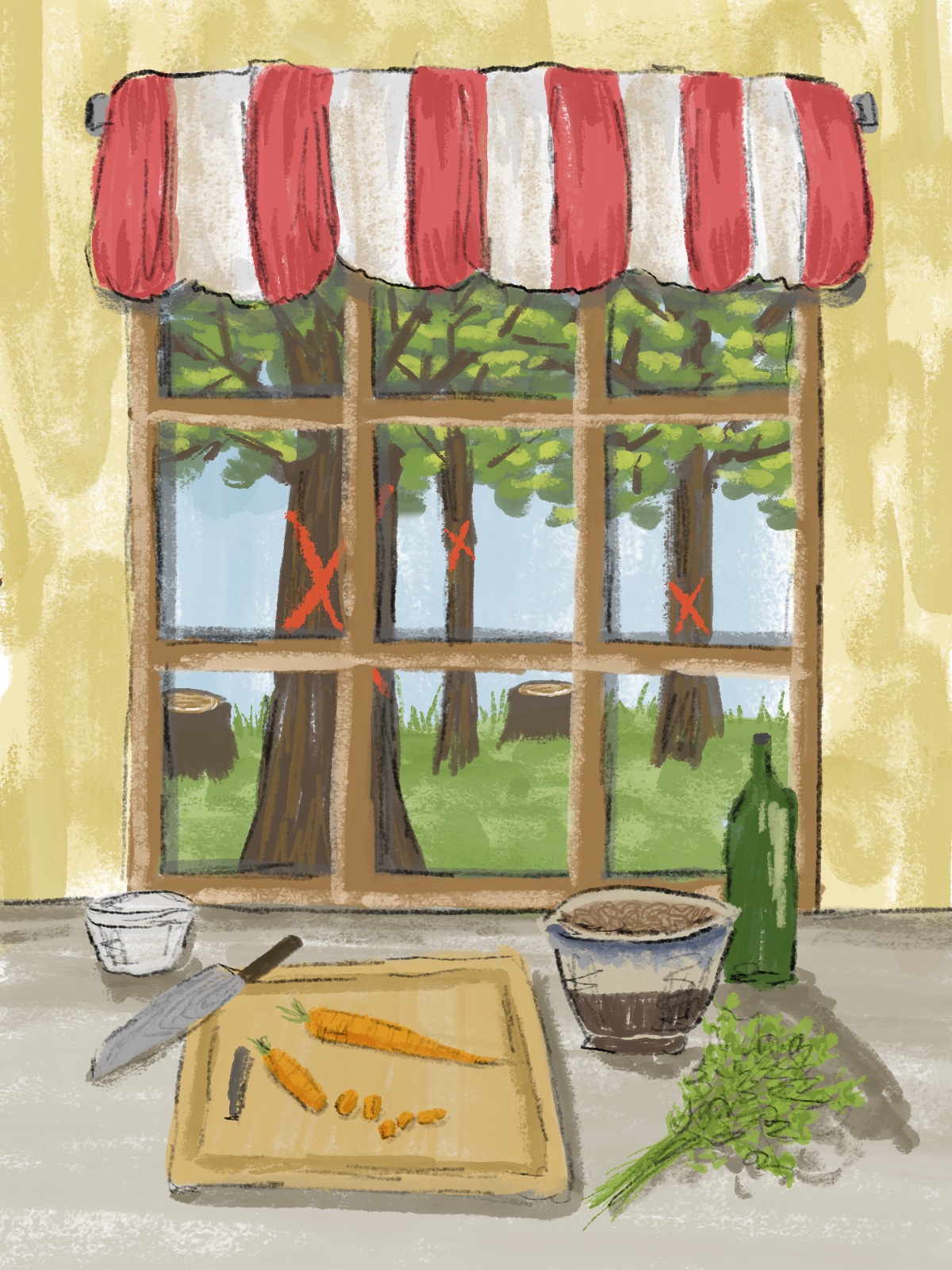
There’s a new fence in the yard where the trellis once kissed the ground, a padlock on the gate in the alley left by an admirer or a forgetful biker. The front door of the house is newly painted navy blue, but the latch still sticks. An assortment of sunscreen bottles, displaced from the back porch, live in the garage alongside the dead dog’s bed, which has been inherited by my parents’ new one. Sunscreen spread on skin, bug spray interrupted by the sound of barking. I throw the puppy a ball, and she runs around the periphery of the yard, still chasing something invisible long after she has caught it in her mouth. Once, we pitched a tent here, but the pea popped up beneath my back. The tent’s been lost for a decade now. Dirt on the lawn chairs, dirt under fingernails, plastic sacks of mulch stacked tall. A smear of Indiana soil on the back steps to be powerwashed come next year. Inside the house, hairballs nestle in the gap between the refrigerator and the linoleum. The countertop is home to packets of tuna, a plastic Brita pitcher covered in hard water film, recalled pistachios yet to be thrown away. On the wall hangs the prim calendar, which still reads “March” in June. On the floor, WD-40 and Clorox wipes share real estate with cans of wet food and salmon dog treats for brain health. I can hear the nettles rattling outside. They’re strewn along the berm so the puppy can’t romp without getting her short legs caught. Through the window, there’s the redbud that sprouted where the garden patch used to be, more tenacious than the tomatoes. It towers over the ghosts of withered vines, the home-farming love fest brief and barely remembered. There is honor in an intact ear, one without the cartilage pierced—my mother said so long ago. But is there honor in an ear that burns? Both of mine turn bright when someone’s grandma asks me if I’m single. She showed my picture to her son. Lucky that breathing fire with a closed mouth leaves the tongue’s flames extinguished. I smile and deflect, teeth thick with ash. Tomorrow, I will drive away, “Wide Open Spaces” on the stereo. No flat land precipice to fall from anymore. The voices haven’t changed. No new timbres, no unexpected inflections, only the occasional quiet indignity. My shadow informs the conversations. Hello to the teenage neighbor I babysat when she was three and I was 12. Hello to my best friend’s brother, who has forgotten my name. Hello to the photo of great-aunts Elaine and Madeline on the mantle. Goodbye to the swimming pool by my elementary school; I used to leap into the water again and again. Goodbye to the cornfield, razed to build a strip mall, and the strip mall, minced and bulldozed to make room for a high rise. Goodbye to the uncertainty that once roiled inside me in the neighborhood where I used to live. I’ve juiced every drop I can from this place. When I take a sip, I taste only the dregs. Two days ago, I boiled soba noodles and cut hot peppers and cilantro for lunch, snapping carrots in half as men sprayed the dead trees outside with red paint and ran the chainsaw. Today, the radio on the porch plays a couple seconds ahead of the one in the living room, the sponsorship message echoing as it sings: “Committed to building a more just, verdant, and peaceful world.”

A Barely Legal Guide to Seasonal Waitressing

On restaurant work and gender relations
October 31, 2025

During your first shift, you will be sentenced to folding silverware into napkins. A test to see if you’re cut out for repetition, the practice will soon become ritual. Take refuge in this menial task on days when your coworkers commit to telling and retelling their recent sexual escapades. There’s no earthly reason why you should know that your middle-aged boss has a penchant for older women. Innocently enough, a bartender at your restaurant may slip you gifts: kombucha, a work of bell hooks, a bracelet—your relationship will meander into allegory. Proceed with caution. When asked how he filled his day, the same bartender might tell you that he “sipped espresso, smoked a cigar, and watched a snail eat a leaf.” When retelling the story to your friends, you will have to insist through giggles that the quotation is direct. Don’t tell them the other things he said. If your manager is acting a little erratic today, he is likely on the come down from an unsavory adventure he took after closing last night. Watch for signs including an increased volume of arguments with the kitchen, palpitating eyelids, and a lowered physical inhibition. He will spill while clumsily showcasing how to pour a margarita with one hand, but beam at his tricks, and he may tip you out of the bartender’s pool. You have precisely one week to get in the good graces of the kitchen staff. Spark conversation in whatever broken Spanish you can eek out. Laugh at the jokes that translate awkwardly into English. Take pride when the head chef calls you “mija.” First uneasy at his kindness, you will soon determine his intentions unsullied. Soldier through incessant teasing along the lines of Hey, remember me? It is best practice to lie and nod. Apparently, the type of men who take their dates to upscale patio bars are also the type to flirt with their barely legal waitresses right in front of them. A hairball sensation will begin to fester in your gut, one that you will fight back into your esophagus when you laugh at his unfunny jokes and nod when he makes no sense. Don’t cough it up. The new 20-year-old chef may slyly pull you aside during rush and ask for a shot of tequila. You will for once find it pathetically endearing—the bartenders will not. He will be fired within three days, and you will feel inexplicably at fault. He wore star patches to cover his pimples, patterning his face with innocence. As the months progress, you will notice a disturbing, albeit useful, pattern. Some days you find yourself crunched for time, hair frizzed from bike rides and lake dips in the summer warmth. Other days, you will bask in the silence of your sun-spotted car—curls tamed, lips painted, cheeks expertly flushed. Take a moment to rehearse a well-placed smile in the rearview mirror. On these evenings, customers will be much more forgiving when the kitchen is running behind. Bat your eyelashes for an extra 5% and don’t think about Gloria Steinem. Whiskey, sugar, bitters, rock, twist. After countless slow hours spent leaning against the bar, you will learn through osmosis to make an Old Fashioned. Carajillo, Sex on the beach, Negroni, Lemon ball: your new party tricks. You never touched the bottle. You never crossed the line. You never would. As the paychecks roll in, guilt will thaw into acquiescence. Exhale your bitterness as the hairball in your stomach softens into the lining. You will exit the summer with an outlook half empty, but a wallet half full.

Buried Alive – Screams of a Stifled Voice

Ava Satterthwaite
October 23, 2025

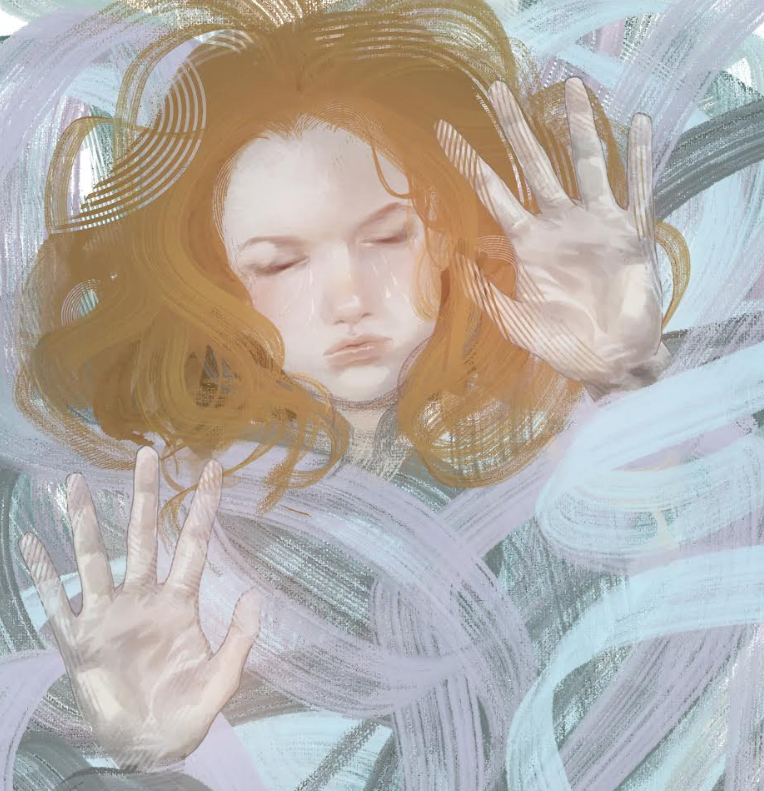
10:32 AM: drilling, grinding, sawdust coats my tongue. i am watching a film – a monochrome mouth moves in silence. a man shouts through the static, his words foreign, unintelligible. the reel flickers. barbed ribbons of cornflower blue obscure the scene, coiling around cranes and metal hooks, colliding with rubber-gloved hands, cutting between construction men in blue. is this show… interactive? i’m in the viewing room, on the table. back and forth and back again. 10:33 AM: the drill closes in. i am concrete: jaw locked, limbs tethered to the table. unable to move or breathe. unable to scream or flail or convince the construction men i am still alive. an entire orchestra of stars shine above me, humming a metallic shrill and showering me inan ostentatious sterilized haze. the conductor calls, “instruments sterilized… bone saw….” screeching. more shrilling. a sudden stabbing sensation, a teeming mouthful of metallic crimson. i flinch – this band sucks. i smack the cold leather below me; the curtains close on cue. 8:29 AM: “No allergies to medication? No food since 12 AM? OK, good… Well, I recommend a Vicodin waiver… She’ll have some soren— no? Fine. Insurance card, please.” I sink back into a tattered cloth chair, gaze fixed on a 1980s Wheel of Fortune rerun. Between Sajak’s comb-over, the wooden TV stand swelling with matted wires, and the stiff faux cactus in the corner, I feel like I've fallen into some neon-crazed, cobwebbed wrinkle of time. Mom offers the card and sits beside me, muttering under her breath as she scribbles a second, third, fourth signature on various forms. 8:47 AM: I take shallow breaths, clammy hands trembling as I scan the waiting room. Phrase: Five Words, 21 Letters W A _ I N G _ P F R O M A _ A D D R _ A M “Ava, come follow me.” How fitting. I walk toward the nurse and exhale as Sajak’s laugh and the dense smell of mildew dwindle into oblivion. Soon, I’ll be dreaming, then delirious with a mouthful of gauze. Soon – it’ll all be over. 9:00 AM: The door creaks. A man in starch white enters – his tall, refined frame harsh amid cartoonish bunnies and fields of flowers sketched on the walls. His smile is courteous, if stiff. “Morning, Ava. I hear you’re our wisdom teeth case today. Junior in high school?” Still scanning the sallow sunflowers behind him, I nod: “Yeah… starting college visits soon.” “Big milestone! License too, then?” He stretches into some latex gloves with such vehemence I wince. “Hopefully. I keep failing the parallel park.” “Ah, double freedom,” he retorts, voice now muffled behind a creased blue mask, “It’ll come.” I hesitate, then: “Um – one thing. I’m a natural redhead, and I read we sometimes need more anesthesia? I think I do, after all the cavities and root canals I’ve been half-numbed for.” I smile sheepishly, tracking cracks in the tiles beneath my swinging legs. “I don’t want to feel a thing.” More amused than concerned, he snickers; “You want the good stuff, huh? Don’t worry. You’ll be fine.” A feverish flush overtakes me, knuckles whitening as my fresh French manicure claws into the armrests. I purse my lips to nothing but the echo of crinkling paper and suffocating smell of antiseptic; the door slams before I can mumble another word. 9:05 AM: The room is heavier now – harsher. Even the fluorescent overheads seem fiercer, like electrified clouds infested with hail, enshrouded with an acute sense of dread. I half-expect the bunnies to flee the fields and burrow somewhere warmer, somewhere sheltered from the commotion. The storm brews swifter as I look down to two cold hands – mottled with bruises and blue veins like marble – still fastened to the vinyl-covered armchairs. I was Rose in Titanic: the bitter Atlantic circled on all sides, but by God, I would hold on to that drifting wood, that stiff vinyl. If this room was a hailstorm, these armrests were my wreckage: a connection to the concrete, to solid land – a lifeline averting an ocean of fear from swallowing me whole. “They’re professionals,” I reassure myself, “trained doctors who do this all the time. I’ll be OK.” I’d identified five items I could see (bunnies, sunflowers, Purell hand sanitizer mounted to the wall, some knives and hooks on a steel, cafeteria-esque dish – the scariest school lunch you’ve ever seen) and two of four items I could touch (the torn sleeves of an old, moth-eaten sweater and the vinyl film on the armrests, of course) when a nurse knocks. She heads for the Purell and asks for an arm. I feel a quick prick, intentionally averting my eyes from the needle to resume the senses’ ritual (two more items to touch… could I fiddle with the IV line? brush the ribbed adhesive at the insertion site? no, that’d be weird). She smiles, gaze flickering to my still-trembling hands, “This’ll calm you down a little, sweetie, OK?” I offer a grateful nod. 9:10 AM: 28. In five minutes, I’d watched the monitor sink from 102 to 83 to 65 (Goldilocks’ zone, breath looser and mind mellower) to the headache-inducing 40, mind-bending 34 (when the bunnies stirred and a breeze made the sunflowers dance – ears smothered in the sound of a million little teeth munching on grass), further and further down until 28 BPM. At 28, neon snow bathes the bunnies, the room an old screen obscured in static. I envision the cactus, the Wheel! of! Fortune! theme, a crinkled People magazine (June 2000 edition, Jennifer Aniston on the cover) and mourn the naiveté of 30 minutes earlier. The tiles teeter as the room tornadoes around me; I seize an armchair with such force the whole chair rocks. Screw Rose, I am Jack: watching myself drown from the hail-ridden clouds above. I sob in slow-motion as my frostbitten hands unfetter from the armrests – Jack’s wooden door unreachable. I am desolate. I am defenseless from fate. A handheld mirror lies slanted on the counter beside me. I search its reflection for what seems like hours. I search this ashen face I once knew for some shred of life – a sniffle of the nose, a curl of the mouth – but to no avail. For a second, I wonder if I’ll die in the smeared reflection: a finale akin only to Narcissus’. After all, 28 isn’t so far from flatlined. Then, 28 climbs back to 33, 34, 42, the sacred 65. I’m not sure what time it is now – or whether it’s been hours, weeks, decades, seconds. I sure as hell am not calmer, though. 9:12 AM: The nurse returns. I ask her the time, what’s in the IV, “will I be under soon?”, each word clear and well-articulated. She’s startled – horrified: this, apparently, was not the desired result. “Wow! I’ve never seen someone so lucid on Midazolam. I– I must’ve halved the dose somehow.” Before I can remind her I’m less reactive to sedatives – before I can tell that snobbish doctor I told you so – she rushes over. “Well, I guarantee this one will work. You’ll be knocked until it’s time for home and ice cream.” She hastily injects another needle, “Count from ten for me.” 10… 9… 8… 7…. Curtains close. A POST-OP REPORT: Recorded 10/02/2022, 11:51 AM EST Patient Ava J. Satterthwaite, 16F, experienced intraoperative awareness and partial temporary paralyzation during wisdom teeth extraction. At 10:32 AM, Dr. Smith [real name omitted] observed REM, increased heart rate, breathing rate, and sweating. Additional anesthesia was administered at 10:33 AM. Prior to operation, patient expressed concern of a potential need for additional anesthesia. Patient reacted unusually to pre-operative conscious sedation, appearing tense and alert rather than lethargic. Patient was administered a typical dose of anesthesia for her size and exhibited anticipated reaction in due time. There is no explanation as to why this dose was not effective throughout the procedure, but patient has not mentioned recollection of said episode – we do not intend to inform her or her mother, to ensure smooth mental recovery post-procedure. Patient exhibited minimal post-procedure reaction, displaying an immediate spatial awareness and producing well-articulated speech. Patient refused a wheelchair and walked to car without swaying or difficulty… indicating provided anesthetic dose may have been insufficient. Quick metabolization of anesthesia was recorded on her chart for future reference. NOV 05, 2022 | 3:02 AM: I am thrust awake, rattled for the third time this week with the acute sensation of suffocation. I feel smooth silk bedsheets crowded in clusters between my clammy hands and exhale. It’s 30℉ outside – bedroom window adorned in chromatic streaks of snowflakes and steam – but I am sweltered. A dense bead falls from my drenched forehead onto the satin. I drink water and stare into the darkness until my shallow breath has thickened. I’ve been buried alive. Again. This ritual started somewhere around mid-October. Initially, I attributed the nightmares to the stacks of wool and fleece and fur I practically drowned myself in every night. So, I switched to silk. For a week, I dozed under one thin linen blanket to the cadence of chattering teeth, waking still at 3AM, smothered, violently shivering. Sometime close to Halloween – when the evening’s installation featured a cornflower blue man and two matted bunnies – I connected the dots. I have lived in fear of doctors since: terrified to miss a stair, catch a cold, drink too much soda – terrified to live.

On MRI Machines, Cabinets, and Freshman Triples

Ina Ma
October 16, 2025

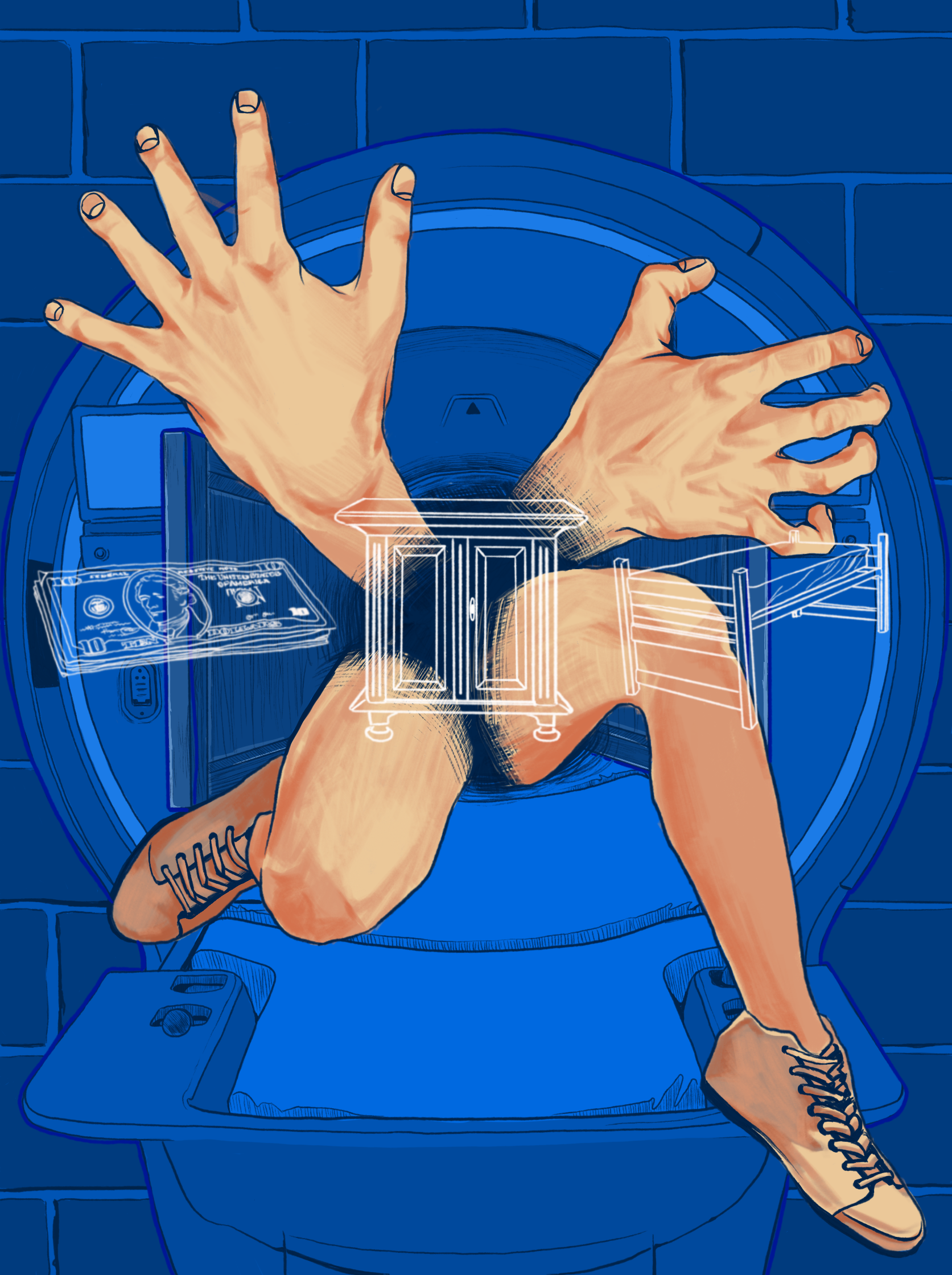
Things they don’t tell you about science: $110. They give you $110 for an MRI study. Or they do tell you, but only after you’ve read the newsletter and clicked the buttons and sent the emails, curious because you never had an MRI before. Then they tell you the magic number you will sell a few hours of your time for, to satiate your curiosity. You write about yourself in the email: 18 year old female, normal and corrected to vision, meets all requirements for the study, no issues, you are nothing less than perfect. Sidney E Frank Hall, opened in 2006, is a beautifully modern glass building that should be put on the front page of a brochure for Brown. The MRI Research Facility is in the basement of SFH, beneath the crushing weight of the five-story, 169,000-square-foot structure. You can touch the ceiling if you stand on your tippy toes. They will put you in an EEG cap and spend two hours gelling you up. They will press the metal nodes against your skull and it will teeter between pressure and pain. The gel gets inserted with a plastic syringe and forms an uncomfortable cool wetness between your hair and the cap. You may fall asleep between the methodical workings of two strangers. It is okay if you have a thin metal wire behind the rows of your teeth, permanently bonded to keep your teeth straight after two years of orthodontic treatment. It is okay if you forgot to mention it the first time they go over the screening questions because you will remember it the second time and your orthodontist will send them an email. The researcher says it is okay and your orthodontist says it is okay. You will still worry that the MRI machine will rip it out of your mouth with its magnetic force, and then your teeth will no longer be straight. The MRI machine is beautiful. She is sleek, white, and powerful, illuminated by a halo of soft yellow light. She thrums beneath your feet because she is alive, sending quiet reverberations running down your spine. The facade is ruined by a gray line of fraying duct tape running down the inner seam of the scanner. MRI immobilizers made of foam and gel slot you into place on the patient table. You feel like a mounted animal, ready to be stuffed and posed—the immobilized yellow perch screwed to driftwood, the paralyzed bluegill flush against his plaque. The patient table is thin and flimsy plastic quaking beneath you as you are mechanically moved into the all-encasing white of the scanner. They cover your body with a white sheet to keep you warm. You are a draped cadaver being slid into the mortuary cabinet. The. MRI. Tube. Is. Smaller. Than. It. Looks. They can taste your discomfort. They are kind. One offers to play a video of fish as they set up. You will watch the video of fish. The fish will swim when you cannot. You ask if you can be taken out between the assignments (no), if they can talk to you during the assignments (no), if you can wiggle your head a little (no). Once you are done with your silly questions, the machine will rumble to life. The song of the scanner swoops between pitches, high to low, beeping to booping. Between each bar the scanner shakes. You are lulled by the machine. Guilt. You aren’t supposed to be dozing off, but you are. Trapped between the sterile white walls of the scanner, your mind is the only thing that can spin, so you sleep to escape. You try to summon the comfort you found in small spaces as a child, squeezing into cabinets and sliding under the bed, but it doesn’t come to you. Don’t let the nausea overpower you. Click your button instead. Click. Click. Click. They will pull you out. You won’t be in there forever. You peel the EEG cap from your head. The gel will have begun to dry and crust on your scalp. You will be annoyed at having to wash it out later. In the moment you will only be able to feel the crashing waves of relief. It surprises you that what surprises you is they pay you in cash. You were expecting something digital, or at least a check. When was the last time you held so many crisp tens in your hand? You will take a nap afterward. about growing up: There exists a hexagonal wooden model a little less than 30 inches in all dimensions and of a deep walnut hue. You are young, so you are only two cabinets tall. The cabinet has a pair of inset wooden doors, each decorated with an ornate curved brass handle. The doors were engineered in such a manner that you can only open one from the outside and have to push the other open from the inside. It takes a tug—the cabinet resists. Online quotes of similar prototypes go up to $1,000, but knowing your parents and the timeline of cabinet acquisition, it was rescued off the side of the road or from a neighbor’s driveway yard sale. It is fun to play pretend. You meticulously move the vintage holiday mugs full of cables, discarded cardboard children’s books, and other miscellaneous items out of the cabinet. The cabinet is your den and you are a mother fox, the cabinet is a mountaintop cave and you are a dragonet, the cabinet is safe and crushing comfort. Slowly, the cabinet will shrink and the space between your skin and its walls will grow smaller. One day, you realize you cannot fit in the cabinet at all. You are hit with a feeling of loss but you do not know what you are missing. about dorms: Some triples are 537 square feet. Some triples are 259 square feet. Some triples have the floor’s electrical closet jutting into the room, making the narrowest part of the room 38 inches wide. Just enough to slot a twin XL mattress. Some triples are too small for three people. Once you move into your dorm, it will be even smaller than before. Your things seem to inch forward, taking up more room until you periodically push them back into place. They are crowding for more space, your space, so you will have to fight for it, shoving clothes into wooden dressers and memorabilia into plastic gallon bins. When you lie on your 38 by 80 inch twin XL at night, you imagine you can feel the walls of the room move to the breaths of your roommates. Your bed is pushed flush against the wall and the wall pushes back—no matter the season, the painted cinder block is strangely chalky and clammy to the touch. You imagine the wall is sweating. Your third roommate moves out. Somehow, the room feels larger and smaller than before. Her part of the room is crossed off with an imaginary line and when you step over, you can feel the oxygen atoms that long exited her lungs rattle around yours. There is nothing left but bare matress and uncovered tabletop. She had the narrowest part of the room. Maybe that’s why she left. The ceiling is stooped so that if you sit on the bed and stretch your spine, you can brush the roof with your fingertips. Neither the overhead fluorescent lighting nor the narrow windows can reach into the dark corner. about all of the above: Forget. Spend the $110, move the cabinet to the garage, pack your things and relocate. Forget the jarring roar of the scanner, the feeling of wood grain against your skin, the sweaty cinder block walls. Fact: you will continue to be forced into spaces too small for comfort. You will never stop growing out of your safe spaces. Every refuge is temporary. Grit your teeth, claw your way out, turn the four alien walls into your home. When trapped, learn to recognize when you should muster courage to stomach the discomfort and when to force the space to fit you. Understand when to move on, and you will burst out of the wooden cabinet that can no longer contain yourself.

Magic: A Sole Collection

Maison Teixeira, Sia Han, Desi Silverman-Joseph, Ina Ma, Luca Raffa, Juliet Corwin, and Annabelle Stableford
May 28, 2025

The fourth edition of our Collections series asks our staff writers to interpret the word “magic,” and all the memories, postulations, and emotions that come with it. From childhood wishes to peeling clementines to the process of illustration and design, our writers probe deep into their schema and produce exciting perspectives on the magical elements within our world. Porku - Maison Teixeira The small island of Brava goes completely dark every midnight, when the government shuts off all the island’s electricity—street lights, lamps, TVs and all. Ne walks home from work and checks his watch—it’s 11:57 PM. He starts to run, but doesn’t make it home before the lights go out on Brava. Luckily, the moonlight is just bright enough to see his path home. Ne keeps running, whizzing by the houses, trees, and bushes in his small, rural town. Then, out of the bushes bursts a PIG, fat enough to roast over a fire, followed by her six stumbling piglets. The mother pig hisses at Ne. He breaks into a sprint, then turns around to find the mother pig galloping behind him, her six piglets in tow. Ne tries to sprint faster, but the pigs always manage to catch up. Stopping to catch his breath at a tree, Ne has an idea. He grabs a branch from the tree and whips around to face his pursuers, striking them with his newfound weapon of choice. The pigs return to the woods, limping and whimpering. Ne 1, pigs 0. *** The sun shines over Brava. Ne walks the same path where his fateful standoff against the swines had taken place a few days prior. On the path is a lady who is followed by her six children. The lady has a sling on her arm, and her kids limp behind her on crutches. “What happened to you?” Ne asks her. She glares at him angrily and walks away, her kids trembling in fear as they stare back at him. Clementines - Sia Han I’m really good at peeling clementines. By good, I mean I can peel one in under 10 seconds and all the way around so all you’re left with is one long, winding spiral of peel. How do I do it? Well, first, get a good grip: dig in your thumbnail and carve out a circle around the little green knob. Make sure it’s wide enough, ’cause if your starting point is too thin, it'll tear. And to be as efficient as possible, peel using the blunt side of your thumb at a 45° angle as you turn the clementine in the other hand. To let you in on a secret though, I didn’t peel my own clementines until I was 15. I hated the way strips of peel and pith would lodge themselves into the crevices beneath my nails, how the smell would stain the tips of my fingers and linger all day. So I always got my mom to do it for me. It was like magic, how with one touch she could tell how ripe a clementine was and how, if she thought it was too sour for my liking, she’d wordlessly put it aside to search through the bag for a better one. How her thumb always seemed to know exactly how deep to dig before piercing skin, her thumbnail reemerging slightly yellow, stained by pith. And how she’d roll it, peel-pith-patches and all, back in one, endless, graceful brush of the hand. I’d watch, fascinated and wary. She complains to me now that her nails have lost the pinkish tint and slight curvature of mine, now yellow, opaque, and flat. It’s like someone squeezed each nail so hard, the edges have lifted and the color has been wrung out like a wet towel. I think I could reach over and just peel one off. Today I peeled a clementine. The skin was very thick, but it was okay because I cut my nails last night. And it ended up breaking three-fourths of the way done, but it was okay because the second piece kinda looked like Brazil. I shared halves with my mom and a bit of juice dripped down my palm, which I licked off. It tasted sweet and bright and good. Habits - Desi Silverman-Joseph Magical thinking. That’s what I heard it’s called. The twelve times I must jump and touch the ceiling when I get ready in the morning. The need to throw my socks onto the bed without them bouncing off before I put them on. The fact that I must put on my left shoe before my right, wipe my butt with certain hands in a certain order, soap up my body from bottom to top in the shower (yes, I know it’s gross). The way I cannot fall asleep without first cracking my back—folding my left leg ninety degrees over the right before reversing this position. It’s the doom I feel if I were to abandon these rituals. The slope between routine and superstition is slick as ice. What starts as an arbitrary habit to make a task automatic or avoid a decision can cement into a terrifying rigidity of mind—into a need that feels as vital as drinking water. What would happen if I forsook the twelve jumps or the sock game? If I put my shoes on right to left, soaped my body top-down like a normal person, violated the rulebook for wiping my ass? Lord, spare me from finding out. The stitches which hold the world together would surely disintegrate, the dams would burst, my downfall would be all but ensured. So please, let me work my magic. Hat Trick - Ina Ma I operate in extremes. It’s unsettling, to sit down with the midday sun hanging high in the sky then blink and find her setting, leaving me behind in the dust because I squandered the afternoon doodling. On other days, I can’t bring myself to open my drawing program lest the sight of the white and gray user interface makes me physically nauseous. The ability to create is as supernatural as any magic. Art is my magic, with shaky/uneven lines and disproportionate anatomy, but my magic. If I am a magician, then digital art is my hocus pocus. Like pulling a rabbit out of a hat, this is a trick I’ve done a thousand times before as my fingers slip over the keyboard, stabilizing lines, gradients, and fill buckets. When the rabbit listens, my flesh does not bind me. The nerves between mind and body are severed, gnawed through, no longer sending the signals requesting sustenance or rest. Every function within my body is working in tandem, synced in stable equilibrium solely to create. Hours are carved out of my day, waking up at five or retiring past midnight, skipping meals and events, to satiate the smoldering desire. I am only brought back to my body when the mental barrier is no longer strong enough to withstand the barrage of physical pain: bleary sight, deep aching in my back, an ominous pain in my wrist that says “impending carpal tunnel.” But sometimes, the rabbit grabs you by the ears. After these bouts of obsessivity, it spurns the suggestion of illustration, thumping its foot in my stomach at any hint of creative effort. It is a motion sickness where the motion is the firing of neurons in my brain. I have a playlist of songs that I would play on loop for hours on end for forays into animation, songs that I do not allow myself to listen to casually, in case the rabbit’s ears catch wind and it comes for me with disparaging rage, twisting knots in my abdomen. At the end of the day, I lure the rabbit back, not with a personal desire to draw or looming deadlines, but with gentle touch and promise of carrots and rest. As much as it wishes it could, the rabbit does not exist without me. It cooperates, and the cycle begins anew. Magari - Luca Raffa I dreamt about a prior life, a life I would not have merely existed in--a life I would have instead lived. I would probably be a peasant picking pears or peaches all day in the orchards; the limoncello sun would pinch me alive with the ripeness of passion and pride, and I would suckle the sweetness of life like the flesh of a persimmon, though my shadow might be my only companion. Or I might be nu piscaturi alone in the water, my golden face rough against the salty winds. I would whistle a charming melody about the fish that could fly across the uncertain sea. I would be as certain as the sun. Then I met you. I woke up, and your eyes appeared like the shallow turquoise waters I saw in my dreams and your hair appeared as soft as those peaches glistening in that sun. You make me see fish flying in the deep blueness of the sky, make my passion turn sour and my pride become mouldy. You make me want to dance to your drunken melody and nourish this helpless feeling. You make me ask God: “what do you call this magic? Love or Foolishness?”. For it is as perfect as lemon blossoms in the springtime. I Believe in Magic - Juliet Corwin When I say I believe in magic I mean I believe in evolution. I believe in growing out of our pasts, that we do not know how to stay still, that we build ourselves along the way. When I say I believe in magic I mean I believe in hands. I believe in skin, that we can touch in a way that does not hurt, that palms can hold all of this life. When I say I believe in magic I mean I believe in dancing. I believe in moving with our heartbeats, that we all have a bit of rhythm aching in our chests. When I say I believe in magic I mean I believe in scars. I believe in healing our wounds, even quietly, that we can create shields out of air. When I say I believe in magic I mean I believe in the big bang. I believe we are explosions, that we are made of stardust, that there is a drop of sunshine in each of us. When I say I believe in magic I mean I believe in sweat. I believe in salt, that we all can glisten, that we can melt and glide and shine. When I say I believe in magic I mean I believe in neurons. I believe that we are electric, firing across synapses, that we create our own sparks. When I say I believe in magic I mean I believe in ladybugs. I believe in wishes, that we make them just in case, and who’s to say they don’t come true after we’ve forgotten them? When I say I believe in magic I mean I believe in wombs. I believe in cradling close, that nests can be made of scraps, that we all learn a way of coming home. Desert Magic - Annabelle Stableford “Avada Kedavra!” Snape yelled, lunging out from behind the sandstone boulder. His black cape swirled in the red dust. Lupin, Ginny, and Hermione froze. The sky was a special kind of blue over the orange cliffs; the sand stung in their nostrils and watered their eyes; they did not know which of them had died. “No—wait—you can’t say that, it’s unforgivable,” I said, dropping Hermione’s accent to make sure my brother Sam, playing Snape, got the message. “Fine, but I’m still evil right now, okay?” Sam said. We all agreed, then kicked our feet in the dry sand as we wondered how to recover from our break in character. “Let’s go to Gringotts,” said Ginny, played by our family friend Liza. “I have a deposit to make.” Lupin, played by Liza’s brother Misha, jumped in: “I’ve heard rumors of a security breach. Keep your guards up.” Hermione, Ginny, and Lupin brandished their desert sticks as they turned to the pock-marked boulders, perfect for stashing gold deposits in. “Wait—and then how ‘bout I’m waiting there to attack,” Sam said. “And then how ‘bout I turn into a werewolf because it’s a full moon,” Misha replied. “And then how ‘bout you chase me and I have to retreat.” We “and then how ‘bout-ed” our way to our favorite boulder with large cubby-holes indented in the rock, where we took our places. As Ginny, Hermione, and Lupin deposited gold, Snape jumped out from behind a rock and yelled, “stupify!” Hermione fell back against the boulder, Ginny cast “expelliarmus!”, then all hell broke loose. Wands exploded, capes billowed in the wind, the battle raged. Darkness soon fell on the land of magic. Our shoes filled with sand and debris from the twiggy brush and our throats ached for water, but Hermione, Ginny, Lupin, and Snape carried on, riveted with adrenaline. As Lupin began writhing in the emerging wash of moonlight, a group of climbers walked down the path, heavy bags of rope and gear shouldered on their backs. They stared at us—our Crocs, our scraped skin, the sticks we clutched to our chests, the way we swished at cloaks they could not see. We took no notice, purposefully ignoring the amused glances the climbers exchanged with each other. “Muggles,” Ginny whispered to Hermione with an eye roll. They would never understand.

Thanks for browsing!

JOIN OUR MAILING LIST!

Thank you! Your submission has been received!
Oops! Something went wrong while submitting the form.