
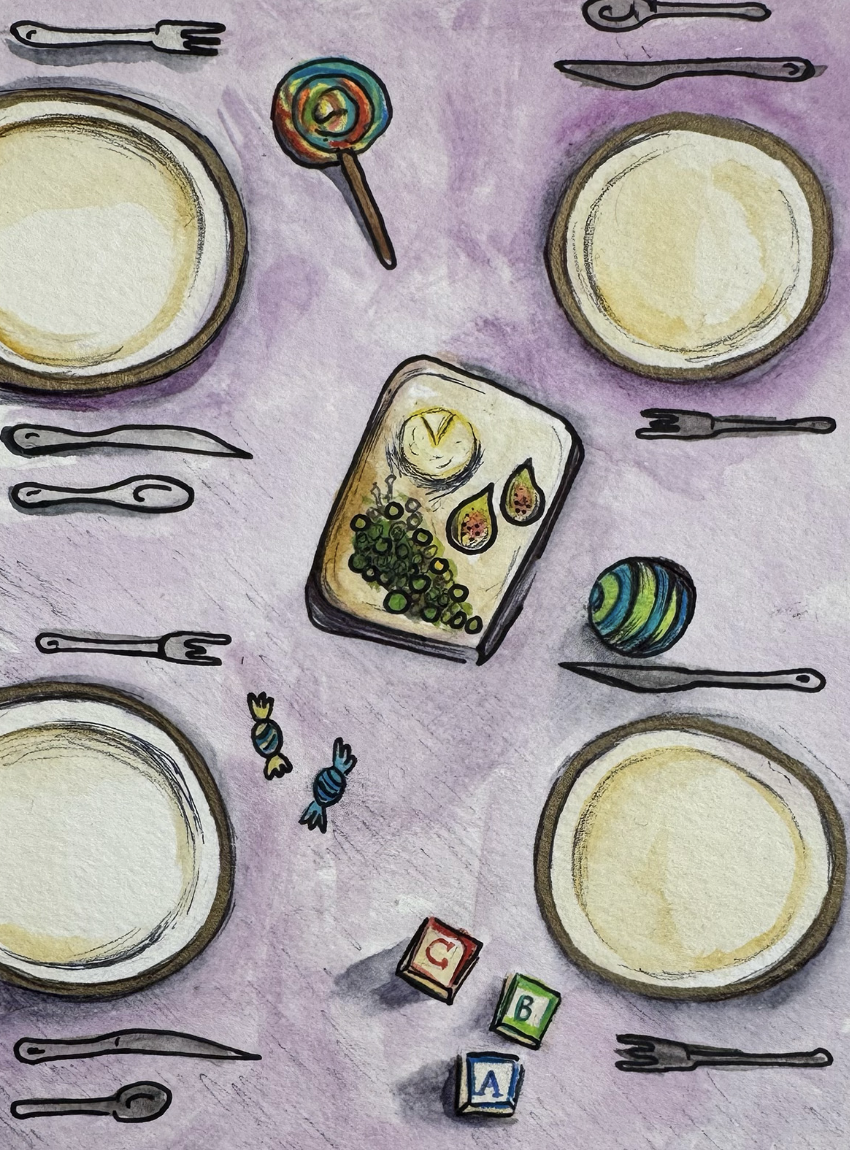
I arrange tea candles on the tablecloth, makeshift and patterned by stains that bleed into the florals. A relic of our parents’ generation, the textile is only thick enough to disguise the aged wood it envelopes when folded twice over itself. Tonight, it bares the weight of the six hours I spent cooking. We have first une salade niçoise served with lightly candied brussel sprouts. A crested hill of layered caprese follows, sliced baguette flowering its perimeter.
Guests arrive in waves. Three are early and two are insultingly late, forgiven for the gossip they bring to the table. She told me he didn’t even wave when he saw her the morning after. Friends present gifts of crisp grapes, whimsical confections, bottles they pray aren’t too sweet. As we find our seats, I wonder: is this the dinner party of our parents’ generation or a reincarnation of our childhood birthday celebrations?
It seems to me as if every young adult loves a dinner party. A gathering classy enough to warrant dressing with inspiration, but intimate enough to speak without reservation. Maybe it’s the breaking of bread, a practice reportedly powerful enough to have united the Democrats and the Federalists, the Wampanoag and the colonists. But just as those narratives are not simple truths, neither is the elation of our careful gatherings. Dining together can be as unpleasant as it is festive. Generations of meals have been the source of unassailable tension: reunions made unpalatable by parental bickering and younger brothers smacking their gravy-smeared lips. In attendance are the people we love—though perhaps do not always like.
Our dinner parties, however, are distinct in their autonomy of choice. In childhood, parents managed the grunt work, pitching fairy-lit tents in the living room, ordering pizza to satiate the crowd. Now, we find ourselves left to our own devices. We create countless lists in the name of adulthood.
Dinner 07.13
Invite list:
Yeses, nos, maybe-sos.
A back-up list if someone falls through; empty chairs thrill no one.
Invitation draft:
Dearest friends, you have been chosen.
Dress appropriately.
Menu:
Parmesan crisped yams, miso butter gnocchi, flank steak.
Made to impress.
Shopping list:
Chicory root, sardines, brie.
The cheapest available.
Setting the table, I think about generations past. Decades prior, someone else a few years older must have stood in this kitchen—a local career politician or an established dermatologist. He too was expecting visitors, but with not nearly as much anticipation. He knew the procedure by rote—when to serve the second course, when to slyly refill his neighbor’s wine glass. He could identify a false laugh and ease a lapse in conversation without skipping a beat.
The guests were familiar, practiced in leaving their shoes at the front door. I can almost place my childhood self into the scene: sunken into the corner chair, across from the man in the ugly scarf. Last time I saw you, I could have fit you in my briefcase! Why do middle-aged academics delight in making middle-schoolers feel small?
Our guests are poles apart, far closer in affect to the children our parents once invited to summer movie nights on our behalf. They stumble at the formalities. Someone might forego the formal dress code for a sloppy pair of basketball shorts; we will say nothing but stare as he meticulously covers his lap with a napkin. Dock one point. Someone else might bring a new boyfriend with no notice; we will feign placidity as he pulls an extra seat between a pair of best friends longing to catch up. Dock two points, maybe even three. But what we lack in finesse we make up for in forgiveness. Friendship is a delicate thing—we know some faux pas are best granted a silent pardon.
Warm light washes down our nerves as the feast begins. Some go all-in, stacking their plates with mismatched goodies brought by unpracticed guests. (Was this supposed to be a potluck? No one quite got the story straight.) Others graze, arms extending clumsily across the table to pluck an olive, a “pardon my reach” carefully uttered. We take an unspoken pride in our maturity, remembering our pleases and thank-yous so far from the oversight of our elders.
The night then goes one of two ways.
The clinking of cutlery might crescendo at half-past nine. Replacing it will be an awkwardness which we bear with guilt. If the spark of enlightened conversation never catches fire, we are left with a table full of friends-turned-family-turned-strangers. We might have worn the badges we found in our parents’ closets with too much assurance. Cause of death: an indulgence of formality and poverty of wine. One can only pretend that they don’t want to talk about sex for so long.
Tonight, however, we evade a tragedy of the commons. The now unlit candles go unnoticed, puttering out one after the other; as the tablecloth dims, our momentum only swells. Half of the crowd is debating the merits of Machiavelli, the other half the audacity of a kid we knew from high school. The catch is, it doesn’t really matter. Everyone is full and no one wants to leave.
Someone reveals an expensively curated box of chocolates from a rumpled tote they had carefully hidden beneath the table. We pass it counterclockwise, excitedly snagging the sweet recommended by the person before. I bite down and my mouth bursts with nostalgia. A buttery shortbread, laced with silky caramel and enrobed in milk chocolate—a Twix bar by another name. I watch my friends bite into rebranded versions of their own childhood favorites: Snickers, Milky Way, Almond Joy. Are they too thinking about Halloweens past? How we zealously provoked territorial disputes over the mounds of sweets poured onto my living room floor. It feels no different than how we tonight bicker over who deserves the final drops from the bottle.
Across the table sits the girl who watched me blow out purple candles on my eleventh birthday. She wore different glasses back then, thicker frames that obscured the brilliant eyes that now lock with mine. I watch her fingers toy with the stem of a glass as she chews her grown-up Kit Kat. To love her is to peer through a foggy window. If I squint, I can piece together the blurry outlines of our past: the pizza parties, the Halloween spats, the movie nights we spent wrapped in blankets on the porch. Then a new image clears—decades of future soirees coming into view. I am elated to see that the future unfolds not at our parents’ tables, but around a table of our own.