
I parked in her empty driveway and approached the proud house with stubborn orange bricks. The black railing guiding me to the door ailed with rust, though the white paint on the house was fresh as the snow. It was dim, the sun obscured in this dull December sadness, and the icy lake winds caused the lampposts to shiver with doubt. I rang the little doorbell and peered around. The short bungalows huddled close together to keep warm from the snow. Darkness was beginning to blanket the neighborhood. Suddenly, a faint light flickered on from inside. I peeked through the doorframe glass with a smile and watched as a figure hurried towards me. The door opened.
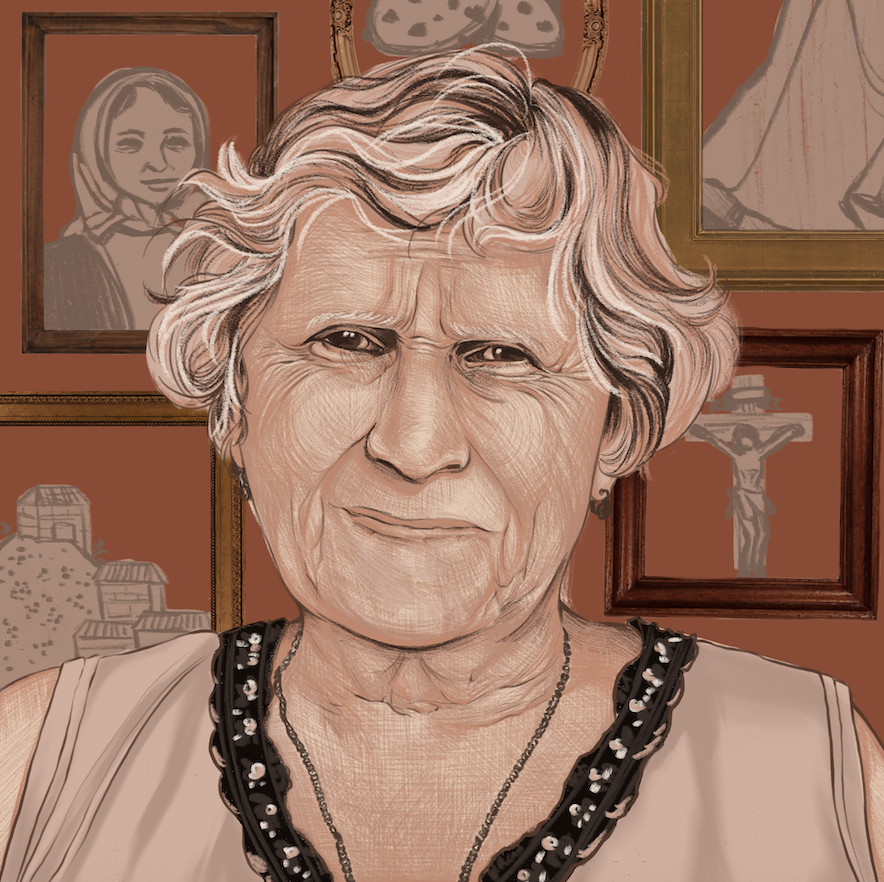
Zia Felicetta greeted me with a tender hug and the touch of her delicate cheeks on each of mine. Her demeanor was elusive, her faint smile always uncertain below her serious eyes––sad, dry eyes which caved into her head and cast shadows. The wrinkles on her cheeks and on her forehead revealed the scars of time, though her small diamond earrings restored some dormant youth still hiding within her. Black strands like needles freckled the white hay that crowned her head.
Zia waddled towards the kitchen, and her plump body disappeared into the dark. A nativity scene of plastic figurines emerged in the corner. Zia had been a widow for over forty years and was the last and only surviving of five loving sisters and their husbands. Across the walls, these ghosts gawked at me, black and white, through the frames: Zia’s husband holding her tight in her wedding dress; her sisters––Carmella, Roquina, Peppinella, and Maria, my grandmother––through the years at her wedding, and at their weddings, and at their children’s weddings; her nephews and nieces who died as infants; the only surviving photograph of her mother Vittoria, the woman she watched die as an infant, wearing a dirt-caked shirt, a shoddy headscarf, and a faint smile; her father as a young man with a black coppola hat and a black mustache; and the same man with a bushy grey mustache and slicked back hair. Hovering higher on the walls were images of saints, Gesù, crucifixes, and a collection of memoriam cards she gathered over years from funerals. She even framed a photograph of Montoleone di Puglia, the town she left behind: a cluster of orange shingles, brown bricks, and white concrete sleeping on a hill and surrounded by green planes and wildflowers.
Zia returned holding a ready plate of cookies wrapped in tinfoil, the wrinkly fat drooping from her arms from the weight of the plate. She invited me to sit at the table and offered me an espresso which I knew I could never refuse. She vanished again into the kitchen, and in the silence of her home I could hear the clanking as she fed the cafetera the espresso grinds and placed it on the stove. When she returned to the dining room table, she unwrapped the cold cookies. She enjoyed making food and freezing it for an infrequent visitor. She put a hard candy into her mouth that reeked of licorice, anise, and fennel and began to suck.
The hot espresso breathed life into us and kindled conversation. She was simple, of little words, knowing only how to talk about her food, her family, her garden, or God. She had no preferences, few opinions. She paused a lot and would watch me. She was a patient woman, watching intently and listening as I sipped on my bitter espresso. When she began to speak, the movement of her firm jaw and soft lips came together in a symphony of schwas. Soon, it was time for me to depart and return Zia to her solitude. Her frail pleas asking me to stay surrendered to my guilty resoluteness, and she disappeared into the basement for one last parting gift.
As I waited for her before the door, I glanced at the frames on the wall again. I started to wonder if Zia ever talked to these ghosts––after all, she was a spiritual woman. Zia emerged from the staircase and brought me more cookies in tinfoil and a panettone to remember her by. She embraced me and kissed each cheek, speaking to me I love you in her unsteady English. I said goodbye.
She waited alone in the frame of the door. The cold followed her inside. I thought about how she might become a photograph someday, and my heart sank.