Brown University's source for creative nonfiction

Featured Pieces

How Much Are You Willing to Lose? Risk Culture and Elite Athletics

August 2, 2024
Annika Coleman

“You can only really appreciate life if you're putting yourself into places that risk it.” – Richard "Milky" Quayle Imagine a bullet. In the Isle of Man, a sleepy island in the Irish sea studded with rocky coastlines and medieval castles, a speeding bullet dares to rip through the warm May breeze at 195 miles per hour. Its path is clean, determined, graceful, powerful. As if immune to the forces of drag or gravity, it flies without apprehension. The bullet is invincible. The bullet is free. Yet, one feature mars its perfection: the bullet has shoulders. “I just caught the rock face with my shoulder. I just snagged it, pulled me into the wall on the right. And then I flew over and hit that [wall] on the left.” Richard “Milky” Quayle is a human bullet with shoulders who dares to race motorcycles at 185-200 miles per hour in the Isle of Man Tourist Trophy (TT) races. Growing up on the Isle watching races since he was a “wee boy,” TT has been a central part of Milky’s life for as long as he can remember. Starting his racing career at 22, he soon became a champion, winning the 1994 Supersport, 1996 250cc Manx Championships, and the Isle of Man TT in 2002. Yet, in the 2003 TT race, he came to learn that bullets aren’t invincible: entering a corner too early, Milky crashed spectacularly into the rocky barrier beside the track, flesh and rocky foundation flying radially in all directions. The crash left Milky with a ruptured spleen and punctured lungs. Milky isn’t the first to be injured in the TT. To the contrary, Milky is lucky not to be dead. Since the event began in 1907, 250 racers have been killed, with six dying in 2022 alone. “The only way of making this event safe is to not do it,” says Paul Phillips, the TT Business Development Manager and Director for the last 15 years. Yet, despite the risk, the flashy collision, and the ruptured spleen, when asked by a reporter in the hospital if he planned to stop racing, Milky responded with clarity: “It's the best thing in the world anyone could ever wanna do. Why would I want to stop it just because it hurt me?” Asta-Sollilja Farrell’s career as a gymnast began at the age of 2 with “mommy and me” tumbling classes. Her career as an injured gymnast began six years later: at eight, she chipped a bone on the side of her foot, resulting in soft tissue damage and a mossy tinge that still taints the skin thirteen years later. At age ten, walking became a challenge: “I started having hip issues. Both of my hips were dislocated and the tendons were messed up. I was in so much pain all the time,” Asta said. “I was in fifth grade.” Since then, Asta has suffered from at least one or two major injuries a year without fail, including an ACL tear, multiple torn ligaments in her left ankle, and six concussions, totalling to approximately 24 major injuries. At the age of twenty-one, Asta has made it, proudly representing the senior class on Brown’s Varsity gymnastics team. 19 years later, the spunky toddler with bouncy brown curls who always dreamed of being a D1 athlete can finally say she is “living the dream. ” Yet, for Asta, dreams have never come without pain. “I have been in constant pain, every day, from the second I wake up to the moment I go to sleep, since I was eight years old. I still have nightmares about retearing my ACL two years post injury because of how much that feeling of crunching replays in my head,” Asta said, her eyes glazed over with resignation. “Multiple doctors have told me that I have to get my foot fused post-gymnastics. I probably won’t be able to walk past the age of forty. That’s my cut off.” However, Asta is not worried about her body post-gymnastics: “I don’t care what happens to my body as long as I can get through this season. In my mind, this is so much more important to me than whatever happens next. I don’t need things to be amazing afterwards, I just need them to be amazing now.” “This is nuts. You know that right?” says journalist Bill Whitaker during his 60 Minutes interview with Milky. The racer giggles at the comment, his perfectly slicked blonde mohawk leaning in towards the camera, exuding a mixture of agreement and pride. “Well, it’s fun though. It’s fun, Bill.” “Let’s unpack that a bit.” My next-door-neighbor Jasper’s favorite line — usually used comically to reference low-stakes gossip — slowly flickers to the front of my mind. I identify as a high-level gymnast turned broken gymnast turned diver turned concussed diver turned medically retired, dazed and confused, permanently-in-pain athlete no longer. I have lived teetering on the border between “within” and “without” elite sports for over thirteen years. As a dual citizen to two distinct worlds, living and listening to athletes’ stories — of success, injury, loss, redemption, pain, guilt, in a multitude of different orders and permutations — I have long viewed elite sports with a critical eye. Hearing the experiences of the human bullet and the gymnast have led to several of my lingering questions beginning to crystalize: How does risk, pain, and injury become normalized in sports? What assumptions lie behind the expression that athletes are “insane” or “nuts”? Is participation in elite athletics justified? “Let’s unpack that a bit” says Jasper. Ok, Jasper. I am scared, yet I am ready. Let’s unpack: what lies within the complex relationship between risk, sports, and glory? Watch the Hero Go Past The practice jumps of Mikhail Baryshnikov, the preeminent male classical dancer of the 1970s and ’80s and principal dancer of the New York City Ballet, spark but one word in my mind: defiance. His pointed toes flying feet off the ground, his kneecaps locked to straightened perfection, it appears as though the laws of gravity apply differently to his slender body. The power in his quads and seemingly effortless coordination of his limbs is almost unnatural, almost not human, or rather, superhuman. The “superhuman” complex is instilled early and regularly reinforced in athletes by both their athletic community and by larger society. Julia Grace-Sanders, former collegiate swimmer at Texas Christian University, recounts that “from a young age, I was told that I was special.” She continues, “My peers stared wide-eyed when I told them how many times I practiced a week. I secretly enjoyed their surprise, and felt affirmed by the astonished reaction.” As a former high level competitive gymnast, I lived a parallel experience: a deep pride grew within me as my middle school teacher’s face flashed with astonishment after learning I spend 24 hours a week in the gym. I reveled in the wild applause of my classmates when I did cartwheels or back flips in PE. I distinctly remember feeling I had a double identity like Kent Clark or Hannah Montana: civilian-student by day, superhero ninja in a bedazzled leotard by night. By the time they reach the collegiate or professional level, athletes have become accustomed to the deep-seated rhetoric that designates athletes as “beyond human” and often propagate this message themselves. As a freshman on the Brown Varsity Swimming and Diving team, I was stunned when our coach read the final line of our team contract aloud: “You must decide whether you want to be an elite athlete, or just another student who goes to Brown.” While the seeming paradox of placing the words “just” and “Brown student” in the same sentence left me dizzy, the fact that not a single girl in the room batted an eye before signing made it clear how commonplace this “glory rhetoric” is within the athletic community. Beyond the pool or the court, Varsity athletes at Brown also openly refer to students who do not partake in Varsity sports as “NARPs”: non-athletic regular people. Slurs for non-athletes are not unique to Brown, with terms such as “muggles” (Stanford), “normies” (Utah State University), or “civilians” (Eastern Illinois University) floating freely across many college campuses. These derogatory terms function to create division between athletes and non-athletes, who are deemed as the inferior “other.” These divisions are publicly visible in Brown dining halls: it is common campus knowledge that the long-table in the center of the V-Dub is off limits to non-swimmers from the hours of 5:30-7pm, that no NARP flesh shall touch the men’s wrestling team’s headquarters by the exit at the Ratty, and that football can formally reserve an entire dining hall quadrant that will be (literally) roped off with red tape. Parties are similarly segregated, with athletes commonly organizing “mixers” with other Varsity teams in which, as recounted by Brown athletes Michelle Guo (swimmer) and Tevah Gevelber (cross-country runner), team members are explicitly told “don’t bring NARPs.” The subconscious assimilation of the “superhuman” complex may also surface unintentionally. For instance, Milky casually glides over the phrase “watch the hero go past” when describing where fans can sit to watch the TT racers, seemingly unaware of the fact that he explicitly refers to himself and his competitors as “heroes.” In a similar vein, Bill Whitticker’s comment “you’re nuts” indirectly validates this notion of the racer as a superhuman “hero” able to push their body beyond the limits of “normal” human ability. The pride that fills Milky’s smile and bobbing mohawk makes clear that, among athletes, being “nuts” is considered a title of high honor. The Sacrifice of Being Superhuman “Guts. Grace. Glory.” is the mantra of USA Diving, the governing body of the sport of springboard and platform diving in the United States as recognized by the Olympic Committee. These words, stamped on a white cloth flag next to a blue and red stick figure flying through the air in a pike position, are the first thing to greet me at dive practice everyday. Waving in the winds and rain of California winter, this catchy alliteration instills but one message in soggy, goose-bumped, exhausted children in swimsuits: their “glory” is the fruit of sacrifice. “Glory” is earned from taking repeated bodily risks until hurling yourself off of a 3 meter springboard appears effortless. “Glory” is earned from exuding courage and resilience in the face of fear, pain, and exhaustion. The high honor of transforming into the heroic athlete does not come without a price. This flag and the word “sacrifice” come to mind when I see a soggy, panting man in the gym donning a shirt with the following white block letters screaming off of the black fabric: “PAIN IS WEAKNESS LEAVING THE BODY.” Originating in the US Marine Corp, this phrase was historically used in recruiting propaganda to encourage youth to enter the US Armed Forces. Taken up by the fitness industry, this line is now found on sports shirts, appealing to the “no pain, no gain” mentality deeply embedded in sporting activities. The “three G’s of diving” alongside the screaming T-shirt serve to exemplify how the aforementioned establishment of a superhuman identity functions to glorify risk taking, normalize pain, and stigmatize weakness. As stated by Michael Atkinson, Professor of Kinesiology and Physical Education at the University of Toronto, in his book The Suffering Body in Sport, sport “socializes young athletes to nearly blindly accept the risk of pain and injury inherent in sport participation,” embracing “pain, injury, and risk as a ‘badge of honor’” that “serves as an important social indicator of one’s commitment to sport excellence.” This culture of risk in sports results in characteristic behaviors in athletes facing pain that include consenting to play while injured, concealing or refraining from reporting injury, and experiencing feelings of pride when training or competing through considerable pain. Asta recounts having done all three by age 14: “The week before nationals, I busted my ankle and could not walk. I was crutching around the house.” Yet, to Asta, raised from the age of two to be a “warrior girl” who perseveres in the face of pain, missing the competition due to injury was not an option. Instead, Asta’s reaction was instinctual: “I started taking six Advil a day on an empty stomach for three months. I had a lot of trouble eating. I did not care. I would take eight if I needed to just to get through the day.” At the competition, she “crunched” her ankle again on vault, twisted it on floor, and distinctly recalls thinking, “my ankle is going to fall the fuck off.” Walking between events, Asta pinned her eyes firmly to the ceiling to hide her tears from the college coaches in the audience looking to recruit their next freshman class. Yet, despite it all, Asta finished the meet, even placing on bars. After her final dismount on beam — which she landed on one foot — her emotions overwhelmed her: “I was so proud of myself. I had gotten through the whole meet and had done moderately well. Who cares if my ankle hurts? I just got eighth in the nation on bars.” To Asta, the immense glory of standing on the podium donning her medal justifies sacrificing the integrity of her soft tissue. To the superhuman-athlete, immersed in the rhetoric of “Guts. Grace. Glory” and “Pain is weakness leaving the body,” exerting your body to the point of near self-destruction is not “nuts”: It is a given. A Coach. An Enforcer. “Kick ‘em out. Curse ‘em out. Embarrass ‘em in front of the gym.” Asta’s tone is matter-of-fact as she describes her club coaches’ strategies for handling gymnasts who were afraid to go for a new skill. “Basically any bad thing you can think of,” she adds, summarizing with her accepting gaze the level of authority and power coaches hold over their athletes. Her words are reminiscent of my childhood: Armen’s screams piercing into Maya three inches from her face after a “sloppy” vault; Jing Jing Zhang’s Adidas sandals flying across the gym to wack 12-year-old Giuseppe for being too “chicken” to go for his dismount off rings; Coach Kelly’s tongue ring banishing my “chicken” limbs to laps around the gym parking lot after crying instead of doing back-handsprings on beam; Sam the literal rubber “shame chicken” being carted around by many 8-12 year old gymnast “chickens” as punishment for any and all expressions of fear. “I was more afraid of my coaches growing up than of any new skill,” Jing Jing always liked to remind us. “At least in this country, you can’t hit children’s knees with sticks.” As stated in Élise Marsollier and Denis Hauw’s paper Navigating in the Gray Area of Coach-Athlete Relationships in Sports, research has shown that “athlete maltreatment in training and competition is not rare, but instead seems to occur more frequently than expected.” Through commonly documented fear- and/or shame-based strategies such as yelling, intentional denial of attention or support, silent treatment, isolating, or belittling, coaches act as enforcers of cultural standards in sports: policing and propagating the importance of exemplifying bravery and suppressing pain. This so-called “tough love” does successfully teach athletes to perform high-risk acts with little hesitation, which may aid in athletic achievement. Nonetheless, even without beating with sticks, placing high moral value on bravery and stoicism while simultaneously creating a fear-based power hierarchy between coach and athlete also increases the risk of bodily harm: “You better suck it up, you better stop limping” were Asta’s coaches words at nationals as she “heavy limped” her way down the runway post ankle-crunch en-route to perform her second vault, her actions reminiscent of Olympian Kerri Strug. "I had to go see a doctor in private who told me my shin was going to split in half if I didn't stop training,” tells former San Jose State University gymnast Alison Falat, who was accused of lying and denied medical care by her coach Wayne Wright after suffering a stress fracture. “Despite the negative impact of these [coaching] behaviors…athletes negotiate maltreatment situations by mostly accepting them through their normalization,” report Marsollier and Hauw, bringing me back to Asta’s accepting gaze and matter-of-fact tone. While the normalization of what is now being labeled as abuse in sports has multifactorial consequences for the young athlete, one of the most salient impacts is the internalization of a destructive mentality: To the indoctrinated athlete, heeding to injury in any way — whether it be leaving a practice early, skipping a competition, or even limping – is considered synonymous with failure. From personal experience, I can say that, once engrained, this mindset is challenging to break. Love is Fraught with Risk Milky: “You can only really appreciate life if you're putting yourself into places that risk it.” Austa: “Gymnastics is more satisfying when you are fighting injuries or mental issues and you are still able to go to a meet and overcome.” “Can you describe to me what you love most about diving?” The writer of my high school newspaper notices how I flinch in response to her question. As a competitive diver, I had became accustomed to answering a certain list of common “normie” queries: → “What’s your favorite dive?” (to which I say 105B off three meter and proceed to get blank stares until I show a video) → “Can you do a flip?” (to which I say, in the most courteous way possible, “No, I actually just spend two hours a day walking around the pool.”) → “You must love it, don’t you?” (to which I always nod and smile, purposely avoiding further self-reflection) Yet, no one had ever asked me why I loved my sport. After embracing some long avoided self-reflection, here’s what I said: “What inspires me to return to the pool every day is the feeling of the perfect dive. When I rip the water beneath my hands, I am no longer controlled by gravity, I am gravity, accelerating at -9.8 m/s² towards the earth through the water, as if the water was simply air, until I finally ‘J-curve’ around, finishing right side up. The exhilaration is addictive.” Beyond the glory associated with superhuman status, according to Michael Atkinson, the act of participating in the sport itself can be “existentially rewarding” because it “provides many participants with a means of experiencing physical, emotional, and psychological sensations not provided in everyday life.” In my case, I delighted in the five seconds of momentary weightlessness followed by the sense of power derived from breaking surface tension with my bare hands. The “exhilaration” was enough to hook me into diving despite the objectively “high-risk” (more on this later). For some athletes, however, enjoyment is not derived in spite of the risk, but rather, as Atkinson outlines, “a significant part of the allure of extreme sports is the degree to which participants place themselves at risk (seemingly irrationally) for the sheer pleasure of being at risk.” Based on Milky’s comment, I would argue that, in the case of TT racing, the pleasure of speeding on a motorcycle at 200 miles per hour derives precisely from the adrenaline of “playing with death” in a way that would not be socially sanctioned outside of the athletic realm. Nonetheless, Asta’s comment highlights that yet a third dimension to the connection between love and risk in sport exists: rather than delighting in the immediate thrill of participation, athletic satisfaction may stem from the delayed pride of having boldly faced and overcome the risk that sport presents. Atkinson describes this phenomenon, saying “the degree to which the body is taxed to its limits (almost sadomasochistically) is meaningful.” Former Brown diver and elite gymnast Carmen Bebbington describes this bodily “taxation”— the post-eight hour practice wailing muscles, overwhelming exhaustion, and deep hunger that drives you to inhale steamed broccoli as if it was a rare delicacy — as “feeling empty.” While perhaps paradoxical, it is precisely this feeling of “emptiness” — the pleasure of endorphins surging through the bloodstream — that I miss most about gymnastics. Even after retiring from competitive athletics, I still consciously strive to push to the point of exhaustion in my daily workouts out of the sheer desire to once again experience the pleasure of “sadomasochistic” physical taxation. For athletes like Asta and myself, loving a sport cannot be separated from the challenge it presents. “Can you describe to me what you love most about gymnastics?” I pose this question to Asta during our interview. As a nostalgic retired gymnast, I biasedly expect her to paint some beautiful description of the joys of flying through the air or the satisfaction of feeling that your jello quads are going to collapse beneath you at the end of practice. Instead, her answer comes as a shock: “Honestly, I really don’t know. It just feels like who I am, and I’ve done it for literally as long as I can remember. I have no memories of pre-gymnastics. The sport kind of sucks: it hurts, it’s scary. But I don’t know, I just love doing it.” While the pleasure of doing the sport can be immense, based on Asta’s comment, I argue that the importance of maintaining the superhuman identity appears to be the most profound influence on decision-making in sports. Whether it be ripping yourself out of bed at 7AM on Saturday mornings to plunge sleepy goosebumps into a chlorinated pool or forcing yourself back up on the beam after an ACL tear, the powerful human need to “know who you are” motivates athletes to continually make sacrifices for their sport. My question remains: can you truly love something that destroys you? The Risk Unseen “I call it the rescue distance.” Amanda is a loving mother. In Samanta Shweblin’s psychological eco-horror novel Fever Dream, Amanda and her young daughter Nina travel out of the city to the Argentine countryside for a summer vacation. Amidst the slow-sultry days spent frolicking through open fields and bathing sunburns in backyard pools, Amanda remains constantly alert: “Right now, I’m calculating how long it would take me to jump out of the car and reach Nina if she suddenly ran and leapt into the pool. I call it the ‘rescue distance’: the variable distance separating me from my daughter, and I spend half the day calculating it.” Amanda’s calculations have long kept Nina’s chocolatey bangs and supple skin safe from the world’s many horrors. Yet, the horror ensues when risk cannot be calculated. Nina’s supple skin begins to itch and rash and writhe as leeched pesticides seep into her innocent flesh from the soybean field upon which she lays. Pulling her daughter’s poisoned body from the grassy-toxic embrace, Amanda has but one thought repeating over and over in her mind: “The rescue distance: it didn’t work, I didn’t see the danger.” Kendall Menard can’t see. After fifteen attempted 5231Ds turned fifteen forceful forehead-to-water smacks off the 1 meter springboard, Kendall stands on the pool deck with her eyes fixed eerily on her extended right hand. “My arm is gone. I only see black past my shoulder.” Us soggy, swim-suited children try to reassure her that we can see her arm, that it looks normal, that it is attached to the shoulder. She isn’t convinced. I reach out and join our soggy right hands. Suddenly her eyes well with terrified tears as she feels invisible sensations from a limb that she is convinced has vanished. I started diving because it seemed like gymnastics but safer. I started diving because water was marketed to me as soft and forgiving. Yet, horror ensued when I started having headaches. After fifteen attempted 203Bs turned fifteen forceful forehead smacks off the 3 meter springboard, I stood on the pool deck wondering why the sky seemed so hazy. Six months later, stumbling through daily life with invisible concussive symptoms, I had but one thought repeating in my mind: I didn’t see the danger. According to a 2016 study of Division I divers from Midwestern universities, 54.2% of participants report having sustained at least one diving-related concussion during their athletic careers. While concussion may result from a flashy skull-smack into the board – such as in the famous case of Olympian Greg Louganis – what is more concerning is that diving-related concussions more frequently result from the mundane crooked entry. As explained by study author Sarah Kemp, a diver’s body enters the water at around 30 mph. Thus, an incorrect entry can cause whiplash effects on the brain as the body decelerates. While the basic physics of diving-related concussions is easily comprehensible, what is more nebulous is why the extent of this risk goes greatly unseen. Risk miscalculation is not unique to diving. In a 2017 study conducted by Christine Baugh, Assistant Professor at the University of Colorado Department of Medicine and Center for Bioethics and Humanities, analytical models suggest that 43% of collegiate football players underestimate their risk of injury and 42% underestimate their risk of concussion. Data out of the UK indicates that injury risk in professional soccer is 1,000 times higher than popularly understood high-risk occupations such as construction and mining. Taken together, these data points lead to a more stratified understanding of the risk unseen: athletes may (a) be simply unaware of the risks associated with their sport (b) be unaware of the likelihood of being affected by such risks or (c) may be unaware of the true extent of the physical harm such a risk may cause. This risk misinformation —combined with socio-cultural factors that normalize pain and injury and glorify the athletic identity — places athletes in a position to make decisions that are not in their best interest. “It didn’t work.” Amanda’s distress plays on repeat in my mind. Her voice calls me to question, how can we make it work? Step one: unblur the risk price tag that athletes read before making a life-changing purchase. Loss is Risky Terrain I don’t remember much about those first two weeks. All I remember is numbness — seeping into the quads, the hands, the mind. The soul. I had limped from injury to injury for two years straight — disc fissuring in the low back, fractured foot, strain in the left inner thigh, second back fracture — too broken to compete, barely mobile enough to train, yet incapable of giving up. My coaches, the preachers of pushing past limits, realized that sometimes breaking isn’t temporary. My coaches spoke the words I could not say: there was no path to comeback. I spent many hours staring blankly at the glossy photo hanging boldly in my kitchen: a blonde girl in a bedazzled leotard soaring over a four inch beam in a 180 degree split. Her focus seemed unbreakable. Her grace seemed infinite. The strength gushing from her muscles reminded me that I was once powerful. I didn’t know if I’d ever feel powerful like that again. Tears dwelled silently in the corners of my eyes, yet I was too numb to cry. As outlined by Atkinson, the risk associated with sports extends beyond physical injury: “Risk is a multidimensional construct of athletes’ minds, bodies, selves, beliefs, values, and identities.” Due to the all-encompassing nature of elite sports, athletes become vulnerable to “self-loss, social loss, [and] emotional loss” as a result of heavily basing not only their identity but their mental-wellbeing on their athletic success. Due to this dependence on their sport, athletes develop a vulnerability not often considered: “Being ‘outside of the game’ is risky terrain” (Atkinson). In other words, contrary to the common belief that leaving athletics eliminates the risk of future harm, career termination represents a significant risk to athletes in and of itself. A systematic review of psychological distress among retired elite athletes found that, depending on the study, up to 29% of the sample demonstrated depressive symptomatology post-retirement, with no study finding less than 20% to identify with diagnosable depression. 39% of retired soccer players were found to have depression and anxiety in a 2015 observational study. A 2017 study revealed that 34.5% of former rugby players who experienced “forced retirement” due to injury were classified as “adverse alcohol” drinkers. Finally, a survey of 644 retired NFL players reported 71% of the sample to misuse opioids and 93% to experience significant pain post-retirement. In combination with depression, chronic pain was associated with difficulties sleeping, managing finances, maintaining social relationships, and exercising. Fast forward eight years and the 12-year-old girl staring at glossy photos in her kitchen is three concussions in and just about to let her newest bodily trauma strip her of a rebound athletic career. Walking solemnly into the “NARP” gym for the first time post-diving, I am confronted with my friend’s gaze of bemusement followed by a phrase I’ll never forget: “you’re mortal.” From the combined experiences of retired athletes across sports, generations, and genders, it becomes clear that “falling back to earth” is a traumatic jolt for the “superhuman” athlete to process. The pain of reconciling with your mortality can become so intense that some athletes in Atkinson’s work define leaving the “total institution” of elite sport as “symbolic death.” Yet, sometimes death is literal. Trevor Labuda dies on November 3rd, 2023, at the age of 24 from suicide. A 2021 Brown graduate and Human Resources Associate at Capital One, Trevor was the captain of the Brown Varsity Dive team, the school record holder for the 1M and 3M events, and the energetic anchor of the Brown Swimming and Diving family. Sitting in a circle in the chaplain’s office, his close friends share memories of Trevor’s raspy voice cheering wildly over the buzz of competition and his bear hugs warming frightened goosebumps after a bad dive. Nick’s voice goes weak as he says, “No one had ever seen Trevor not in an awesome mood.” The tears once again start to dwell in the corners of my eyes, yet I’m too numb to cry. “While no one factor is believed to be the root cause of suicide ideation or attempt, losing one’s identity as an athlete through forced or voluntary retirement is noteworthy along sociological lines” says Atkinson. Trevor was in the process of transitioning out of a fruitful 14 year diving career, symbolically changing his instagram handle from “@trevthediver” to “@trevthedover.” He had a loving girlfriend, a stable job, and many die-hard fans (myself included). No one can define his suffering for him. No one can explain away his death. All I know is that Trevor joins the many revered athletes tragically lost to suicide: Junior Seau (NHL), Rick Rypien (NHL), Kenny McKinley (NFL), Wade Belak (NHL), and Ellie Soutter (Olympic snowboarder) among others. “Grief is the flip side of love,” says the chaplain at Trevor’s memorial, finally breaking our silence dotted with harmonized sniffles. “Love is a risk, but that doesn’t mean you should stop yourself from loving.” No matter the complex establishing factors or the frequently painful endings, one thing is clear: athletes love their sports ferociously. Despite the physical injuries they produce, the sacrifice they entail, and the grief that accompanies their loss, is it justified to prevent people from expressing this love? Should future generations be deprived of their chance to experience it? And Yet. “Last question: will you put your kids in gymnastics?” Asta does not hesitate: “Not a chance.” At the age of 21, my body is abnormally weathered and restricted: the bilateral tendon tears in my feet and lower leg spread numbness and burning into my toes as I stand at the sink to brush my teeth. The twisting required to roll out of bed must be carefully executed to prevent the electric surge of SI joint instability from shooting into my back and lower abdomen. Post-concussive migraines taint physics homework and roommate dinners with fog, fatigue, and sustained eye twitching. I often lie awake at night grappling with the unsettling reality that there is no escape from pain. My mom sat beside me on cold metal chairs as the orthopedist announced that the longitudinal tears in my feet tendons will eventually need to be surgically “tacoed” back together. When I asked him where exactly on a calendar “eventually” is, he replied with a daunting “you’ll know.” Every day I cautiously roll out of bed, awaiting the moment I will no longer be able to walk. Tears began to dwell in the corner of my mother’s eyes, but she was not afraid to cry. “I wish I had never put you in gymnastics,” she whimpered into my ear. Suddenly the metal chair felt like ice beneath my forearms. And yet shaking, cold, and terrified, all I can think is that I’d do it all again. I’d do it all again for the existential weightlessness of flying over a four inch beam in a perfect slip, I’d do it all again for the burst of pride and adrenaline that surges through the stomach after sticking the perfect vault at regionals, I’d do it all again for the beautiful exhaustion that filled every inch of my flesh after a four-hour Saturday practice, I’d do it all again to hear my teammates scream-cheering from across the gym, I’d do it all again because I can’t imagine who I’d be without ten years dressed in leotards and coated in chalk, I’d do it all again because to this day I still consider myself a warrior girl, and I’d do it all again because despite the burning and despite the aching and despite the twitching, what pains me most is knowing that I will never again do what I loved so ferociously that it destroyed me. “It's the best thing in the world anyone could ever wanna do. Why would I want to stop it just because it hurt me?” – Richard "Milky" Quayle Last question: Is participation in elite athletics justified? It depends how much you are willing to lose.

Most Recent

Most Recent

On Foss Hill

Elsa Eastwood
March 8, 2026

I am a California native in the Northeast. It's my first week in the season that I've been told I won’t survive, and I am bundled in clothes—a scratchy scarf, two pairs of pants, a big blueberry parka and a knit hat—all newly purchased. The sun has just risen and crisp air burns my nose. A fresh coat of snow sits heavily on the limbs of trees. Having forgotten to account for the time it takes to layer, I’m running late to class. I glance anxiously at my watch and hurry through the blanketed streets. Out of breath, I arrive finally at the top of Foss Hill, the steep, icy slope that stands exactly between me and the classroom I’m supposed to be in two minutes from now. I lean over the edge to scout my path. After yesterday’s storm the day prior, Foss Hill has been sledded and skied down a great deal. Overuse has scraped any layer of powder clean off, leaving only a frictionless, glistened plane thinned by sunlight. Small outcrops of rock and grass puncture through its marble-like surface, and the whole sheet has been darkened to a murky black-grey. To my left, a paved, well-trodden path winds its way lazily down the incline, doubling back on itself in long, patient curves. But I hate being late, and straight down is the fastest way. Thinking of Robert Frost, I quickly convince myself that descending Foss will not only get me to Intermediate Spanish on time, but will prove me a true maverick—what was once a choice against all reason becomes one of authenticity, and perhaps even courage. I take one precarious step forward. It looks worse than it is, I tell myself. In an instant I find myself skimming rapidly downwards on my butt, my bald-treaded boots flying through the air, limbs flailing. Rows of pine trees and red-brick spires fly past in my periphery. At the bottom, I’m flushed and shaken. Chill seeps through the pockets of my jeans. I close my mouth, which must have fallen open at some point along the way, and wince as small bruises form constellations across my tailbone. I look again at my watch. My class has begun. But the urgency that led to my fall seems to have been lost somewhere in it, and in a moment of catharsis and humiliation I lie back against the hill, laughing awkwardly to myself, not knowing whether to bow or apologize or forget going to class at all. The world narrows suddenly to the question of whether I’d been seen. I swivel my head. The campus is nearly empty, aside from a stranger wearing a backpack and a hefty red coat. He stands, eyeing me, surrounded by snow like a dot of blood or cranberry juice on white carpet. “You good?” “Yes,” I reply. “Thanks.” He nods, burying his nose into his scarf and resuming the trudge forward. I lift myself up by my palms and follow him as whatever spectacle I thought I’d made dissolves into the cold.

Entrance

Sara Harley
March 5, 2026

Second floor, end of the hall on the left. As I turn the dented brass door knob, the wooden door creaks open, revealing the narrow expanse of my high school door room. It’s just after seven o’clock on the night of my eighteenth birthday. Setting my ratty canvas tote aside, I find a seat on the old carpeted floor and wait for the day to spoil. The silence feels like another reminder of the passage of time. Only seniors can live in single rooms. After spending my early teenage years sleeping next to strange roommates with foul-smelling microwaveables, I usually cherish privacy. But today, I’d shower in shrimp–flavored ramen for propinquity. My roommates and I almost never spoke, but I wish for closeness. I moved away from the hills of northern California to go to boarding school a few months after I turned fourteen. My high school is only a three-hour drive south—two and a half, if you’re lucky—situated in a little beach town. I left because I loved school perhaps a little too much. This is my fourth year living in dorms. Surveying the walls, the dark wood and cream-colored paint are dotted and scratched with age. Decades of Command hooks and adhesive sticky tape marks cover the walls. I had tried to cover the age by hanging family pictures and post cards from art museums, but they don’t quite fill the gaps. I know that when I try to gently pull them from the walls next month, they’ll just add to the defaced paint—an enotropic right of passage. No more than a hundred square feet, it’s a shoe box, but transitively mine. I wander over to my beige vinyl desk. Opening the center drawer, I peer down at the names Sharpied onto the wood: Callie Harris from ‘07, just-Maggie from the year 2000, and dozens of other signatures from women who have lived in this very room. Over the years, signatures have accumulated all over campus—written inside gym lockers, carved into the wooden tables in the dining hall, and even painted in acrylic on secret cervices in the art room—from students trying to make their mark. Some signatures are more elaborate than others, with flourishing cursive capitals and consonants; others write over previous students’ names with bold, confident letters; but most of the inscriptions are small and neat like good Catholic school girls. The ink on my drawer is beginning to bleed from accidental splashes of water, blending shades of the blue-ish black, red, green, and pink into monolithic brown. Pushing away a stack of Post-it’s, I uncover the signature of Sharon Wallager ‘90 written right in the center with big, calligraphic letters. Who was she? I almost Google her, but decide against it. Better not to kill the mystery. The way somebody signs their name can tell a lot about a person. Personal marks that seem to say I was here. During middle school, many of my friends practiced theirs like a mantra on scrap paper. Every time my dad pays for dinner, his pen makes the same scratching noise—slow and curled, and then finishes with a lick. Whenever I sign documents, I gulp and try to write my first name in haphazard cursive as quickly as I can, hoping to make a similar noise as my dad. The desire to create a signature feels so masculine. My unquenchable desire for a gold star makes me nervous to sign my name, and yet, I feel compelled to do so anyway. It's times like these that makes me regret never designing a signature. The permanent pen feels permanent, too irreversible, without an autograph. Except for a handful of dorm faculty, like my Welsh world religions teacher, I doubt anybody will see the signatures but those who will live here after me. One of these days, I’ll find a secret spot and sign my name to the drawer like a yearbook that will never be finished— a lineage that I’ll never know but feel everyday. Across from the door, a mirror and a window hang over my desk. There are fingerprints on both from careless mornings. Peering into the mirror, I often like to imagine the reflections of previous tenants looking back at me. My high school—a Catholic college prep school for girls—opened in 1950. I can see my hair cut into a little gauche bob curled at the bottom. My plaid uniform kilt is a few inches longer, but my collared shirt still has the same little embroidered crest on my left collarbone. I think I would’ve been more graceful had I been born then, but I would’ve despised home economics. Making up stories makes me feel less guilty for forgetting to buy Clorox wipes. Sorry, dad. Seeing myself now after another year under the beating sun, I notice how my reflection has changed: my jaw appears narrower and the skin around my cheeks grows drier from the chlorine at swim practice. The inertia of my fleeting youth and the inevitability of getting older scare me. Rubbing the delicate skin around my eyes, I wonder where time has gone. The friction against the glass proves pointless. My physics teacher pops into my mind and reminds me that an object in motion stays in motion. The sun is beginning to set. Looking out the window, the light begins to fade in the distance from golden to pink and orange. At least the sunshine appears to be doing the plants some good. Leaning against the side of the window between bookends are miscellaneous copies of Dover-edition Shakespeare plays, a highlighted Camus, my diaries, a little whiteboard for Spanish verb conjugations, a few old print copies of the New Yorker, and about a dozen classics that I hadn’t read, but made me feel smart for owning. The curtains around my window are barely worth mentioning, except for the fact that they’re light blue, come with the room, and just a little too ugly to be cute. I cast a glance at my two ferns, a pothos, and an old ivy sitting in front of the glass. They’re beginning to take up more space than I can manage. My newest addition is a baby fern from my biology teacher after the national exam. No larger than an espresso mug, I have a bad habit of smashing its little stalks between the pages of my colossal biology textbook, so its pointed leaves have dried yellow and brown spots, instead of dark, judicious green. The rest of them are from a bookstore with a plant atrium in the back. I loved going there during my freshman year on the weekend shuttle—a school bus that looks like half a stick of butter—going south toward the beach to pick out their pots from an eclectic selection of cat heads and funky colors. I picked out white ceramic ones because they had little drainage holes in the bottom, and I have an overwatering problem. I grab my neon orange water bottle named Jamie from on top of the dresser beneath the mirror, unscrew the leaky cap, and divide whatever's left between the four pots. It couldn’t hurt. I thought the ostentatious color would help me not forget him places, though my swim coach and the upper school office would say otherwise. Evoking moans and groans from my friends, he became a micro campus celebrity as a result of the many places I’ve left him—leaning against classroom desk legs, sitting on the edge of the pool deck, hiding under a pew in the campus chapel. Covered in stickers, I can just make out one from a coffee shop nearby—a little tandem bike with a rainbow surfboard. There’s another from a family trip to southern California, one from an affirmative action political protest with flowers in the shape of ovaries, and a few gifted––and a couple stolen––from friends. After dropping Jamie in the rain, bonking him on the side of desks, forgetting him on the pool deck, and letting him fall out of the side pocket of my equally defaced Northface backpack his once-smooth surface has become disfigured. Even so, his scratches and dents make him feel like mine. I decide to return to the floor. Grounding myself beneath the sterile ceiling lamp, I slouch against the linoleum drawers below my sleeper-sofa twin-XL. The cold artificial, blueish-white hue is dissatisfying. Through the semi-translucent light shade, I can see a spotted graveyard of dead moths. Only a month before graduation, I felt the room had already begun preparations for my departure. I notice a thick humid haziness gathering in the cubbyhole-sized space. I couldn't help but feel the room was moving on without me. If I really squint, I can see the brownish carpet is composed of different shades of blue, maroonish, and mustard threads, hiding decades of soda stains, hair, remanence of rumpled pastries. and loneliness. Leaning my head against the mattress, I feel the arms of my dad’s old sweatshirt graze against my back, sticking out from the plastic drawers from below my bed. I have a bad habit of chucking soiled clothes in the closet when I’m in a hurry, which pull my neatly hung dresses down with them. Toss in damp, miscellaneous pool equipment from swim practice and you’ve got a party. The soft cotton stitches of my multicolored hippie quilt pull tighter. After a long morning of celebratory phone calls and texts chock-full with emojis, my phone finally stops glowing. My friends are retired in their rooms to prepare for our last round of exams. Bending my knees toward my chest like a child with a stuffed animal, I settle my phone in my lap. Scrolling, I look up at the popcorn ceiling and back down again, waiting. For what, I wasn’t quite sure––everyone I hoped would text or call already had. Swiping between videos from politics to celebrity drama to cute dogs in little hats, the distractions weren’t distracting enough. Finally, I open my photos app instead, and begin to look at old photographs from my childhood. I was born on the first of May—May Day—a holiday marked by flower crowns and ribbons. I remember that time of year best during elementary school. The school year would be almost over, the blacktop would begin to make a mirage again from the growing heat in the afternoon, and the grocery store watermelon would finally stop tasting so mealy. I share my birthday; I have a twin sister, but boarding school is so not her thing. Since I left, we haven’t spent a birthday together for years. My dad loved to throw shared birthday parties for my twin sister and I. Shared cake, shared cards, shared friends. We both secretly wished we could have separate celebrations, as if to somehow prove we were, in fact, separate people. Luckily, we’re fraternal. I remember sitting side by side at the kitchen table while our family sang happy birthday off-beat––two names instead of one. She hated the song, but I loved looking at how our dad smiled when he sang to us. As kids, I think we both believed sharing a birthday somehow meant we were half as celebrated. But every year since I left for high school, I find myself reminiscing about her, wishing she’d teleport. I realized she was the celebration. On our eighth birthday, we invited both of our elementary school classes to a tropical-themed party. There were rainbow balloons, cut fruit, heavy water guns, cupcakes, and inner tube galore. Our friends screamed and laughed, wearing dark Nike swim shorts and flower patterned cover ups. Rays reflected off the pool and made our skin glow. As the afternoon sun waned, it was time for my dad’s pièce de résistance: the watermelon relay race. I loved being competitive, but I had, and still have, terrible stage fright. Standing at the ledge, we were divided into two teams and organized into lines. “Sara, why don’t you go first?” My dad asked, smiling. He still has the pink polo he was wearing then. “Do I have to?” “Come on—it’ll be fun! Here, take this.” While he was trying to downplay it, my dad asked me to go first because, well, nobody else wanted to. I can’t remember who started the other team. But then, materializing seemingly out of thin air, he handed me a gargantuan watermelon. Hugging it to my chest, my arms ached from its weight. I prayed my melon wouldn’t split in half and put on my best game face while my dad walked to the other side of the pool to referee. Yelling, he told us to swim—there and back! The victorious team won stickers and first dibs on dinner. Raising his fingers for the countdown, I prepared to jump. 3…2…1… But looking back at cupcakes and sun-kissed cheeks on the boundary between adolescence and adulthood, getting older feels like nothing to celebrate. I remember when I thought my childhood would never end, when I thought being seventeen would mean lockers, boyfriends, and house parties until three. My seventeen looked more like study hours from 7:30-9:30 monitored by the dance teacher, Accutane, and mandatory mass on Sundays. A transitory age, the ordinariness makes me feel like I took the fast track to adulthood. The curve in my spine begins to ache against the bedframe. Setting my phone aside, I watch the setting sun’s rays stretch through the window like a cat arching its back. As I reach for the door, the aged wood shines. After so many years of chipping, knocking, and jamming, the ridges of the smoothed trunk still glow bright beneath the worn varnish. Sliding on my dad’s rubber sandals, I wander back down the hall again.

Gemini Season

Elaine Rand
February 20, 2026

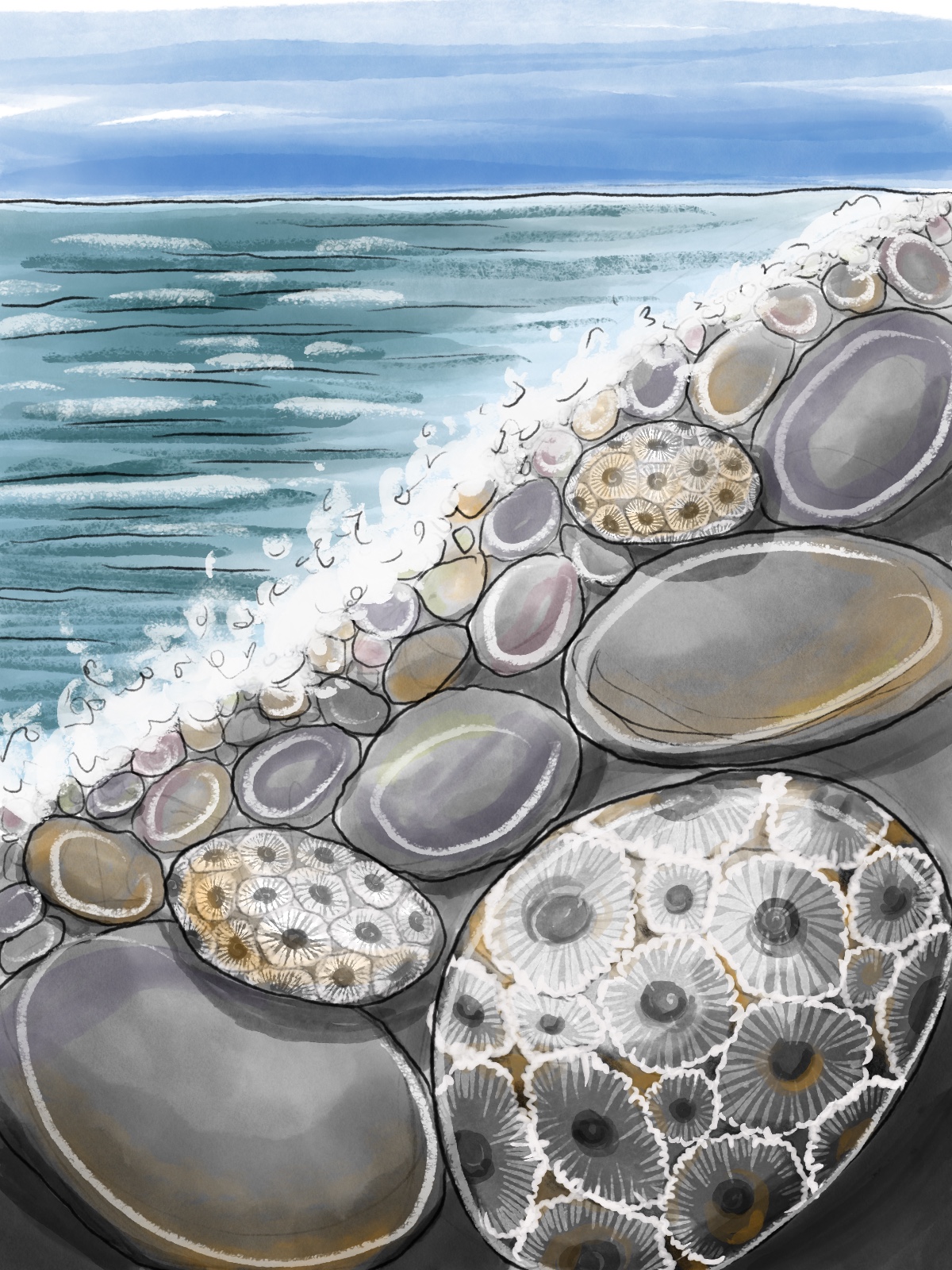
Before the world was big, before Benefit Street and Big Bend Boulevard, before Achilles tendonitis and all the awkward annual apple pickings, before I was worried about mono and mold, I had the impression that every summer would be the same. And that’s because, for a while, they were. We used to drive up into Benzie County in northern Michigan sometime during Gemini season to get some time by the lake. There was the wooden platform under the cottage we’d stay in, home to roots and rodents, a bunker of sorts. The windy bike path around the lake that led to the gift shop full of beeswax soaps and honey sticks. The caramel agate and grey Petoskey stones, freshly tumbled, their patterns like tectonic plates trying to shift around one another. The vacationing family in the next cottage over, whose kids made me a little nervous (they crushed at shuffleboard). When I first came, I avoided the other kids and their pavement games—too much pressure to make a good impression. I preferred skipping rocks and paddling out to the bobbing wooden rafts alone, lifejacket chafing at my neck. By my final visit, I’d gotten brave. The tetherball pole became my purview. It stood at a lean, barely secured under the lakefront sand. But were all those summers really the same? There was the year I came a day late, voice hoarse from the strep throat, digital thermometer and bubblegum pink antibiotics double-bagged in brown paper; another year, with strep again, this time missing out on two days in the cottage. There was the year my dad left early to go to a friend’s funeral, and my mother drove us home at 6 in the morning to get the rental car back on time. I sang loudly to keep her awake, occasionally pinching her cheeks at her request—was I allowed to sit in the front seat that young? I dipped my fingers into a crushed Ice Mountain bottle and touched my cool, wet hands to her temples as she drove through the dark. The first Michigan summer I can remember, when I was five, a golden bee stung the tip of my big toe while I sat in the sand, and I spent the rest of the day inside. It felt like such a waste. Silly me, getting a sting at nine in the morning, before I’d even gotten in the water. I wore hot pink water shoes from then on. I’d look forward to our Michigan trip all year. The state itself became my obsession, the lakefront the setting for each of my daydreams. I thought I’d find true love there by the bonfire. I looked for signs in the face of any sweatshirted teenager who passed me on the beach to see if they saw anything in me. I thought I could swim to the other side of the lake, if I tried hard enough. I didn’t know it was eight miles long. There was another family who overlapped with mine for only one summer, whose toothy twins I continually mistook for each other: Caroline and Kelly. They were nine, I was seven. We’d roast marshmallows together under the stars and try to match the constellations to the ones printed in my well-worn library book. Gemini was barely visible, but we found Ursa Major just fine. The twins rode horses back home in Kentucky. We stayed pen pals for a couple years. Their mother addressed the envelopes with loopy flourishes and big circles to dot each “i”. Their town was one of those hit hardest by the tornado last May. Now the planets have shifted positions a million times over and the shoreline is disappearing and I haven’t visited the lake in nine years. New starscapes, new summers, new lakewater levels. New families at the bonfire, new rodents’ nests under the cottage. But how would I know? So, you see, without the anticipation of the annual trip, without the routine of it, the guarantee of new faces for daydream fodder, the water’s placid constancy, it’s easy to prickle when Gemini season rolls around. No more whistling lakeside breeze for me, just the pitter-patter pattern of the rain on the cement. The tropical levels of humidity haven’t arrived just yet, but they will soon. There will be signs.

Across the Atlantic and Back

Maison Texeira
February 19, 2026

1975. Shirley dreams that she’s at her job, working behind the counter at a small bar called the Devon in the seaside town of Hartlepool, wearing a white T-shirt with a Penny Farthing bicycle on it. A handsome guy walks in with a lovely smile, brown skin, and jet black hair. They talk for a while, until she wakes from the dream. A few weeks later, Shirley sits behind the counter at the Devon, wearing the same white T-shirt, only this time she’s awake. That’s when the man of her dreams walks into the place and asks her for a drink. They talk for a while, until he and his crewmates are called back to the ship, and he leaves to set sail once again. The man of her dreams, otherwise known as Big Manny, comes back to visit Shirley occasionally. Eventually, he makes her a present: a Penny Farthing bicycle made out of nails driven into a piece of wood. She loves it, and soon enough, he comes over to stay with her and the son she’s been raising by herself. They live together, but not really; he’s away most of the time, cooking delicious meals for hungry sailors adrift on the merchant ships. When he’s back home with her, they go to the disco together, boogieing all night to Earth, Wind, & Fire, the Stylistics, and Donna Summer. They’re spectacular dancers; they can do the Bump, the Hustle, they can Rock the Boat, and everything in between. Today, Shirley is still a spectacular dancer, but she tells her grandson that nobody could dance like her husband used to. Her grandson wishes that he’d inherited some of their dancing genes. ~ 1977. Shirley and Big Manny have a child together: a chubby, white, red-haired boy whom they also name Manny, otherwise known as Little Manny. Five years later they have another, a brown-skinned girl with black hair whom they name Maria. They carve out a life in Hartlepool, with Shirley taking care of the kids and Big Manny continuing to live out at sea, coming home for one month out of every year. Hartlepool isn’t always kind to their family, being one of few mixed race families in the town. One time, a boy throws a brick at Maria’s head and calls her the N word, and Little Manny fights back by throwing several bricks at his head and beating him up. Little Manny gets into tons of scraps with other kids, but most of them are with his older brother John, who torments him — and loves him — like no one else. John can beat Little Manny up all he wants, but as soon as anyone else so much as lays a finger on his younger brother, he shows up to break that finger, as well as maybe an arm or two. Little Manny also has many girlfriends growing up, but his first true love, the one he’ll someday meet and bear a child with, is all the way across the Atlantic, in a country he’s never even heard of. ~ 1986. In the third-world metropolis of Belize City, there lives a woman named Vianney who is raising her daughter Melanie and her infant son Sergio. Melanie is a feisty young girl, running around the city with her younger cousin Camille. The city is their oyster, and yet it is also a dangerous place. This is a city where old men carry crocus bags and use them to try to catch young girls, which almost happens to Melanie and Camille one day. This is a city where watching a woman almost drown in the canal is nothing unusual, at least not to the wide, curious eyes of little Mel. And worst of all, this is a city where Tataduende, the dastardly dwarf with backwards feet and a penchant for stealing children's thumbs, is believed to roam from time to time. Melanie often conceals her thumbs within her fists when she walks about. This is a city of peril and poverty, yet Melanie only sees the wonder of it all, especially in the big, gaping eyes of the kittens she and Camille find at the corner store. They bring the kittens back to their great-grandmother Mims, who had asked them to get her some tea bags, not these adorable kittens. Mims explains that Melanie and Camille have failed to consider the fact that they are very, very poor. How are they going to feed these kittens? ~ 1989. Shirley and her family decide to move to the United States of America, on the Northeast coast of New England. That’s where most people who left Big Manny’s homeland of Cabo Verde have wound up, and it’s where his two sisters and most of his brothers call home. Little Manny, Maria, and John all enroll in school, where Little Manny is scolded for staying seated during the Pledge of Allegiance. “I don’t pledge allegiance to this country,” he says to the teacher. They do American things, like going to McDonald’s, where John tells Maria to give him all of her fries because he heard that “McDonald’s supports the Irish Republican Army.” Little Manny makes lots of friends, who come to know him as “English Manny,” and his accent makes him a catch with the girls at his school. He and his friends live on the edge, riding their dirt bikes through abandoned factories and going toe-to-toe with each other in bareknuckle street brawls. Shirley misses England dearly, and later admits to her grandson that she never wanted to move to America. When she returns to her home country for the first time in twenty years, she finds that it’s no longer the England she remembers. ~ 1989 (still). The same year Shirley and her family move from England to the Americas, Vianney and her 9-year-old daughter, Melanie, move from the Americas to England, while Sergio stays behind with his Dad. Melanie is excited, her little Caribbean mind imagines England as the land of fairytales and royalty. When she gets there, there aren’t any fairies, and she doesn’t meet any princes or princesses, but she does find things like clean sidewalks, dentists, rubbish bins, and street sweepers — luxuries that didn’t exist in her home country of Belize. They’ve moved here because her mother has married an English army man, who hits her and calls her names. He is sent to Iraq for months at a time, and Vianney and Melanie savor these months without him. Vianney begins to know England as home, much more so than Belize, which is slowly becoming a much-desired tourist destination for its beautiful sandy cayes. While talking to her grandson many years later, she laments that the Belize she knew as a child is gone, and that the Belize where snotty American tourists spend their winter holidays is not the Belize she wants to return to. ~ 1997. Little Manny, who is no longer little anymore, travels back to England frequently, attending raves where DJs play techno, trance, and house music as a pulsating sea of people dance. At one of these raves, Manny lays eyes upon the most beautiful girl he’s ever seen. Manny approaches the girl and asks her name, which she says is Melanie. They strike up a conversation, and he asks her if she’s seeing someone. She says she’s seeing a guy named Danny… who just so happens to be Little Manny’s best friend. Nevertheless, they form a friendship that blossoms over the years. Manny spends his early 20s living many lives. He lives one life as DJ Synista, renowned in the Providence nightclub scene for spinning techno records that transform empty Brown University halls into living, breathing dancefloors, where college students boogie their cares away. He lives another life in Tenerife, a married life, one that somehow survives for some time after his pet ferrets devour all of his wife Eleanor’s gerbils but still ends in an unceremonious divorce. Eventually, Big Manny’s son moves back to Rhode Island, where he continues his usual escapades with beautiful women — all of whom he completely drops after convincing Melanie to come fly back across the Atlantic to the States, where she’ll live with him. In the meantime, Big Manny takes up work in the restaurant business. He becomes the head chef at Cantina di Marco, a cozy Italian restaurant in Cumberland, RI, of which he will soon become the sole proprietor. He’s finally found a home for his five-star cooking after many years traversing the globe on merchant ships. Cantina di Marco becomes a second home for Big Manny and his family, a second home populated by strangers who come through its double doors to dine, drink, and mingle. These strangers don’t see the inner workings of Big Manny’s crowded kitchen, where chefs toil over stoves and chopping boards, but the savoury flavor of his signature prime rib or his alfredo linguini speaks volumes to the culinary brilliance hiding behind the kitchen’s swinging doors. ~ 2025. Manny and Melanie are no longer together, but they have an unbreakable bond that’s lasted twenty years and looks a bit like both of them, with his mother’s hazel eyes and his father’s round head. Their son, Maison, was once a wide-eyed little boy with an afro, sitting on his father’s knee as Manny recounts the moment he met his first true love. Now, he’s a young adult, carrying the stories of his parents and their parents with him wherever he goes. His grandad, Big Manny, lives on in his memories. He remembers Cantina di Marco as though it never closed down, remembers sitting in a trolley with a big grin on his face as Big Manny pushed him around the parking lot, remembers chilling at home with Big Manny as they munched on bananas and pretended to be monkeys. As a young adult, Maison will one day find himself writing a creative nonfiction piece about how his family came to be. He will write this piece in his now-retired grandmother Vianney’s back garden as she reminisces in the kitchen with her daughter, laughing about Melanie’s escapades in York. He will write this piece while sitting next to his mother Melanie and asking her what her life in Belize was like. He will write this after having spent several weeks with his father Manny, who’s back in England after all these years, now living happily with his second love Chantelle. He will write this for his family, a family which is, quite literally, beyond the wildest dreams of a young English girl working at a bar in the quiet seaside town of Hartlepool.

See More

Our Mission

Our Mission

Sole Magazine was created to provide the Brown community with entertaining and informative feature writing about true events, people, and experiences but without the stylistic restrictions of hard journalism. We aim to tell interesting stories in interesting ways, using techniques of characterization, description, and theme, while experimenting with structure and tone to produce creatively crafted narratives.

Meet Our Team
SAO Disclaimer

The content of UCS/GSC recognized student organization websites is generated independently from Brown University. The statements, views, opinions, and information contained on the site are personal to those of the authors and student organization and do not necessarily reflect those of Brown University. The content on the site is not reviewed, approved, or endorsed by Brown University or its faculty or staff.