Brown University's source for creative nonfiction

Featured Pieces

The Wandering Albatross

January 23, 2025
Stella Kleinman

The strongest ocean current in the world is the Antarctic Circumpolar Current, coursing through the narrowest chokepoint around the White Continent. Average water flow is 4.77 billion cubic feet, over 600 times the volume of the Amazon River. With 40 foot waves and 50 mph winds, the Drake Passage from Argentina to Antarctica is a uniquely violent journey believed to have caused thousands of shipwrecks. I’m sitting by the window watching the world churn. The boat is pitching—skyrocketing up and plummeting down over wave after wave. If not for the gentle hum of the engine, I wouldn’t know we are moving forward. From the front observation deck, I can feel split seconds of weightlessness, where my throat becomes a vacuum and heart strands get caught between my teeth. Anyone with any sense is in their cabin, hiding from seasickness under ceilings, sheets, and eyelids. A smooth, dark silhouette fills the window, interrupting the vast expanse of otherwise empty sky. At first, I think it’s a spot in my vision– a hallucination from too many nights at sea. How could this stranger, this creature of solitude, find us here? Lifted by long, sleek wings, the massive bird glides across the air as if it’s a solid surface. With dark eyes narrowed ahead, it tilts back and forth on its axis to catch the harsh gusts. The sea falls to its knees at first brush with the bird’s wingtips, a kiss that stops at the lips, suspending itself in the air. Last night, Marten, an expedition leader and ornithologist, presented a PowerPoint about the wandering albatross. We sat on the floor like young children, watching him click through videos breaking down the bird’s flight patterns. The albatross flies in a unique style called dynamic soaring, which involves gracefully swooping through wave troughs on a cyclical path. Carving elegant lines through the sky, it can fly for a thousand miles without flapping its wings. Marten’s eyes glinted as he told us the birds spend the first five to six years of their lives without ever touching land. They can circumnavigate the globe in 46 days, sleeping with half their brain at a time. From behind the window, I watch the white-headed albatross swoop and fall and glide, tracing its flight path with my pointer finger. It is a being of wind and power, one of the elements rather than fauna. In one of my favorite poems, Samuel Coleridge’s lyrical ballad The Rime of the Ancient Mariner, a sailor shoots an innocent albatross for no apparent reason, cursing his voyage. The crew endures storms, spirits, and haunting mist as the dead bird hangs over the captain’s neck, a symbol of curse and punishment. The albatross’s mistreatment at human hands signifies the plight of the poet, violent acts against nature with catastrophic consequences, and individual sacrifice. Compulsory storytelling. The bird’s white head dips forward as it catches a gust and effortlessly outruns the ship along the air. My breath fogs up the window glass. Where are you going? Where have you been? What is it like to live surrounded by nothing but air and water, to fade into the horizon day after day? What do you miss? What can you call your own? The albatross answers with a glittering downward swoop. The first time I step on Antarctic land, I am so far away from home that my body is no longer my own. Blue ice crystals glow around my feet as far as I can see, hanging over themselves and creeping forward as time stands still. Every so often a chunk screeches and splashes into the churning ocean. Snowflakes bundle and roll, speckling the harsh slopes of jagged mountains. I picture a holy-handed giant taking a pocket knife to a block of obsidian, carving away sharp bits. Eating each slice of rock off the knife, one by one, then disappearing into the sky. I wade through water so clear and smooth I would try to mold it like clay if I didn’t know any better. I try to survey it all, but my gaze keeps snagging on rock piles and tumbling into snowbanks and slipping down the sides of icebergs into the silent ocean. I feel like I could melt into my feet, or catch a draft of wind and plummet upwards to the tips of the black mountains. I wonder if the sun still sets somewhere, if the streetlamps in my neighborhood still flicker, if the world is still spinning the same way, if I have ever been anywhere else, if I am still my mother’s daughter. If someone reached out and touched me right now, would their hand pass straight through me? I am stuck in time but nowhere in space, existing only elsewhere. I wonder if the wandering albatross leaves a piece of itself on every wind it catches, drawing lines around the globe. Ancient mythology refers to the albatross as the Prince of the Wave, a mystical spirit of lost sailors possessing healing powers and prophesizing divine fortune. By observing these birds, sailors adjusted their course to avoid harsh weather. To hurt an albatross, as demonstrated by Coleridge, was to unleash the wrath of the sea. When I was younger, I couldn’t fall asleep without first finding the North star out my window, or guessing where it was on cloudy nights. In a place where the sun does not set, what do you center your world around? What is it like to be as untethered and alone as the albatross, beak careening forward through empty space? On the seventh night, we leave the ship, hauling packs twice our size. Anthonie and Kai trek in heavy red coats, testing snow and whispering hastily in Dutch. Finally, they decide on a somewhat flat plot of snow as far as possible from seals and avalanche risks. They hand out shovels like goodie bags at a child’s birthday party, if candy and toys could protect from 20 mile per hour winds. Antarctic gusts are in the rare category of things you can only burrow under, never climb over or stand against. When it’s finally my turn with the shovel, I feel like I am digging my own grave. I lay down to mark the size hole I need, then hack into the snow. Fine powder scatters to the breeze every time the spade goes over my shoulder. I am cutting into the Earth’s southern crown, making room for myself in a place unlike anywhere I have ever been. Once I’ve dug a three-foot deep coffin, I gently arrange my two sleeping bags and tuck myself in facing the still-bright sky. Sharp gusts tumble over me, and I welcome the cool air as it buries itself in my lungs. As the temperature drops, snow crystals begin to freeze around me, molding an imprint of my body. In my mind, I am here to stay. I will crawl into this shoveled-out cove each night, watching the animals around me to know when it’s time to sleep. I will live off of mackerel icefish and Antarctic cod and melted snow. Each morning I will make it a little bit farther up the mountain and carve words into the rock, and then retreat. After a while, I will stop thinking about what I am writing. I could really do it. I lay on my back with my eyes open, breathing in the southern sky. A wispy cloud rolls down toward me, obscuring the mountaintop. Every so often, little gentoo penguins splash in and out of the water, always in groups—unlike the albatross, with its commanding wings and daunting spirit. For the first time since meeting it, I feel a dull ache for this mystical creature with no dwelling, this lonely flier. I pull my blankets tighter around me and sink into the earth’s embrace. I don’t know if I managed to sleep tonight, but I know I woke up. The crushing melody of Anthonie’s boots on the snow’s brittle surface invites me back to my mind. It’s four a.m., and we have a long passage to the next island. Once my eyes adjust to the light and I remember where and who I am, I grab a shovel from my neighbor and begin refilling my bedroom with snow. I pack it in and pat it gently, evening the surface so that there is no trace of my stay. I kneel silently atop my handiwork until my knees are soaked and it’s time to go. Back on the ship, I find my body in the same seat on the observation deck. The waves are gentler closer to the shore, and we are rolling side to side rather than pitching. I’m not sure how long I sit hugging my shins before I see it. Another albatross, beak open, dancing up and down along drafts. This time, I don’t question its solitary trajectory or spiritual meaning or how and why it can only chase or flee. I watch the polar breeze wrap itself around the bird’s wingtips and think about interlacing my fingers with my best friend. I watch the sea meet its feathered underbelly as it swoops downward and remember every time I fell asleep in the car as a child and my parents carried me to my bed, every leaf pile my brothers and I jumped into during the early Autumns of growing up, and every pendant a friend has fastened around my neck for me. I think of the way the spirit of the ocean protects the albatross, and let it glide out of my sight.

Most Recent

Most Recent

On Foss Hill

Elsa Eastwood
March 8, 2026

I am a California native in the Northeast. It's my first week in the season that I've been told I won’t survive, and I am bundled in clothes—a scratchy scarf, two pairs of pants, a big blueberry parka and a knit hat—all newly purchased. The sun has just risen and crisp air burns my nose. A fresh coat of snow sits heavily on the limbs of trees. Having forgotten to account for the time it takes to layer, I’m running late to class. I glance anxiously at my watch and hurry through the blanketed streets. Out of breath, I arrive finally at the top of Foss Hill, the steep, icy slope that stands exactly between me and the classroom I’m supposed to be in two minutes from now. I lean over the edge to scout my path. After yesterday’s storm the day prior, Foss Hill has been sledded and skied down a great deal. Overuse has scraped any layer of powder clean off, leaving only a frictionless, glistened plane thinned by sunlight. Small outcrops of rock and grass puncture through its marble-like surface, and the whole sheet has been darkened to a murky black-grey. To my left, a paved, well-trodden path winds its way lazily down the incline, doubling back on itself in long, patient curves. But I hate being late, and straight down is the fastest way. Thinking of Robert Frost, I quickly convince myself that descending Foss will not only get me to Intermediate Spanish on time, but will prove me a true maverick—what was once a choice against all reason becomes one of authenticity, and perhaps even courage. I take one precarious step forward. It looks worse than it is, I tell myself. In an instant I find myself skimming rapidly downwards on my butt, my bald-treaded boots flying through the air, limbs flailing. Rows of pine trees and red-brick spires fly past in my periphery. At the bottom, I’m flushed and shaken. Chill seeps through the pockets of my jeans. I close my mouth, which must have fallen open at some point along the way, and wince as small bruises form constellations across my tailbone. I look again at my watch. My class has begun. But the urgency that led to my fall seems to have been lost somewhere in it, and in a moment of catharsis and humiliation I lie back against the hill, laughing awkwardly to myself, not knowing whether to bow or apologize or forget going to class at all. The world narrows suddenly to the question of whether I’d been seen. I swivel my head. The campus is nearly empty, aside from a stranger wearing a backpack and a hefty red coat. He stands, eyeing me, surrounded by snow like a dot of blood or cranberry juice on white carpet. “You good?” “Yes,” I reply. “Thanks.” He nods, burying his nose into his scarf and resuming the trudge forward. I lift myself up by my palms and follow him as whatever spectacle I thought I’d made dissolves into the cold.

Entrance

Sara Harley
March 5, 2026

Second floor, end of the hall on the left. As I turn the dented brass door knob, the wooden door creaks open, revealing the narrow expanse of my high school door room. It’s just after seven o’clock on the night of my eighteenth birthday. Setting my ratty canvas tote aside, I find a seat on the old carpeted floor and wait for the day to spoil. The silence feels like another reminder of the passage of time. Only seniors can live in single rooms. After spending my early teenage years sleeping next to strange roommates with foul-smelling microwaveables, I usually cherish privacy. But today, I’d shower in shrimp–flavored ramen for propinquity. My roommates and I almost never spoke, but I wish for closeness. I moved away from the hills of northern California to go to boarding school a few months after I turned fourteen. My high school is only a three-hour drive south—two and a half, if you’re lucky—situated in a little beach town. I left because I loved school perhaps a little too much. This is my fourth year living in dorms. Surveying the walls, the dark wood and cream-colored paint are dotted and scratched with age. Decades of Command hooks and adhesive sticky tape marks cover the walls. I had tried to cover the age by hanging family pictures and post cards from art museums, but they don’t quite fill the gaps. I know that when I try to gently pull them from the walls next month, they’ll just add to the defaced paint—an enotropic right of passage. No more than a hundred square feet, it’s a shoe box, but transitively mine. I wander over to my beige vinyl desk. Opening the center drawer, I peer down at the names Sharpied onto the wood: Callie Harris from ‘07, just-Maggie from the year 2000, and dozens of other signatures from women who have lived in this very room. Over the years, signatures have accumulated all over campus—written inside gym lockers, carved into the wooden tables in the dining hall, and even painted in acrylic on secret cervices in the art room—from students trying to make their mark. Some signatures are more elaborate than others, with flourishing cursive capitals and consonants; others write over previous students’ names with bold, confident letters; but most of the inscriptions are small and neat like good Catholic school girls. The ink on my drawer is beginning to bleed from accidental splashes of water, blending shades of the blue-ish black, red, green, and pink into monolithic brown. Pushing away a stack of Post-it’s, I uncover the signature of Sharon Wallager ‘90 written right in the center with big, calligraphic letters. Who was she? I almost Google her, but decide against it. Better not to kill the mystery. The way somebody signs their name can tell a lot about a person. Personal marks that seem to say I was here. During middle school, many of my friends practiced theirs like a mantra on scrap paper. Every time my dad pays for dinner, his pen makes the same scratching noise—slow and curled, and then finishes with a lick. Whenever I sign documents, I gulp and try to write my first name in haphazard cursive as quickly as I can, hoping to make a similar noise as my dad. The desire to create a signature feels so masculine. My unquenchable desire for a gold star makes me nervous to sign my name, and yet, I feel compelled to do so anyway. It's times like these that makes me regret never designing a signature. The permanent pen feels permanent, too irreversible, without an autograph. Except for a handful of dorm faculty, like my Welsh world religions teacher, I doubt anybody will see the signatures but those who will live here after me. One of these days, I’ll find a secret spot and sign my name to the drawer like a yearbook that will never be finished— a lineage that I’ll never know but feel everyday. Across from the door, a mirror and a window hang over my desk. There are fingerprints on both from careless mornings. Peering into the mirror, I often like to imagine the reflections of previous tenants looking back at me. My high school—a Catholic college prep school for girls—opened in 1950. I can see my hair cut into a little gauche bob curled at the bottom. My plaid uniform kilt is a few inches longer, but my collared shirt still has the same little embroidered crest on my left collarbone. I think I would’ve been more graceful had I been born then, but I would’ve despised home economics. Making up stories makes me feel less guilty for forgetting to buy Clorox wipes. Sorry, dad. Seeing myself now after another year under the beating sun, I notice how my reflection has changed: my jaw appears narrower and the skin around my cheeks grows drier from the chlorine at swim practice. The inertia of my fleeting youth and the inevitability of getting older scare me. Rubbing the delicate skin around my eyes, I wonder where time has gone. The friction against the glass proves pointless. My physics teacher pops into my mind and reminds me that an object in motion stays in motion. The sun is beginning to set. Looking out the window, the light begins to fade in the distance from golden to pink and orange. At least the sunshine appears to be doing the plants some good. Leaning against the side of the window between bookends are miscellaneous copies of Dover-edition Shakespeare plays, a highlighted Camus, my diaries, a little whiteboard for Spanish verb conjugations, a few old print copies of the New Yorker, and about a dozen classics that I hadn’t read, but made me feel smart for owning. The curtains around my window are barely worth mentioning, except for the fact that they’re light blue, come with the room, and just a little too ugly to be cute. I cast a glance at my two ferns, a pothos, and an old ivy sitting in front of the glass. They’re beginning to take up more space than I can manage. My newest addition is a baby fern from my biology teacher after the national exam. No larger than an espresso mug, I have a bad habit of smashing its little stalks between the pages of my colossal biology textbook, so its pointed leaves have dried yellow and brown spots, instead of dark, judicious green. The rest of them are from a bookstore with a plant atrium in the back. I loved going there during my freshman year on the weekend shuttle—a school bus that looks like half a stick of butter—going south toward the beach to pick out their pots from an eclectic selection of cat heads and funky colors. I picked out white ceramic ones because they had little drainage holes in the bottom, and I have an overwatering problem. I grab my neon orange water bottle named Jamie from on top of the dresser beneath the mirror, unscrew the leaky cap, and divide whatever's left between the four pots. It couldn’t hurt. I thought the ostentatious color would help me not forget him places, though my swim coach and the upper school office would say otherwise. Evoking moans and groans from my friends, he became a micro campus celebrity as a result of the many places I’ve left him—leaning against classroom desk legs, sitting on the edge of the pool deck, hiding under a pew in the campus chapel. Covered in stickers, I can just make out one from a coffee shop nearby—a little tandem bike with a rainbow surfboard. There’s another from a family trip to southern California, one from an affirmative action political protest with flowers in the shape of ovaries, and a few gifted––and a couple stolen––from friends. After dropping Jamie in the rain, bonking him on the side of desks, forgetting him on the pool deck, and letting him fall out of the side pocket of my equally defaced Northface backpack his once-smooth surface has become disfigured. Even so, his scratches and dents make him feel like mine. I decide to return to the floor. Grounding myself beneath the sterile ceiling lamp, I slouch against the linoleum drawers below my sleeper-sofa twin-XL. The cold artificial, blueish-white hue is dissatisfying. Through the semi-translucent light shade, I can see a spotted graveyard of dead moths. Only a month before graduation, I felt the room had already begun preparations for my departure. I notice a thick humid haziness gathering in the cubbyhole-sized space. I couldn't help but feel the room was moving on without me. If I really squint, I can see the brownish carpet is composed of different shades of blue, maroonish, and mustard threads, hiding decades of soda stains, hair, remanence of rumpled pastries. and loneliness. Leaning my head against the mattress, I feel the arms of my dad’s old sweatshirt graze against my back, sticking out from the plastic drawers from below my bed. I have a bad habit of chucking soiled clothes in the closet when I’m in a hurry, which pull my neatly hung dresses down with them. Toss in damp, miscellaneous pool equipment from swim practice and you’ve got a party. The soft cotton stitches of my multicolored hippie quilt pull tighter. After a long morning of celebratory phone calls and texts chock-full with emojis, my phone finally stops glowing. My friends are retired in their rooms to prepare for our last round of exams. Bending my knees toward my chest like a child with a stuffed animal, I settle my phone in my lap. Scrolling, I look up at the popcorn ceiling and back down again, waiting. For what, I wasn’t quite sure––everyone I hoped would text or call already had. Swiping between videos from politics to celebrity drama to cute dogs in little hats, the distractions weren’t distracting enough. Finally, I open my photos app instead, and begin to look at old photographs from my childhood. I was born on the first of May—May Day—a holiday marked by flower crowns and ribbons. I remember that time of year best during elementary school. The school year would be almost over, the blacktop would begin to make a mirage again from the growing heat in the afternoon, and the grocery store watermelon would finally stop tasting so mealy. I share my birthday; I have a twin sister, but boarding school is so not her thing. Since I left, we haven’t spent a birthday together for years. My dad loved to throw shared birthday parties for my twin sister and I. Shared cake, shared cards, shared friends. We both secretly wished we could have separate celebrations, as if to somehow prove we were, in fact, separate people. Luckily, we’re fraternal. I remember sitting side by side at the kitchen table while our family sang happy birthday off-beat––two names instead of one. She hated the song, but I loved looking at how our dad smiled when he sang to us. As kids, I think we both believed sharing a birthday somehow meant we were half as celebrated. But every year since I left for high school, I find myself reminiscing about her, wishing she’d teleport. I realized she was the celebration. On our eighth birthday, we invited both of our elementary school classes to a tropical-themed party. There were rainbow balloons, cut fruit, heavy water guns, cupcakes, and inner tube galore. Our friends screamed and laughed, wearing dark Nike swim shorts and flower patterned cover ups. Rays reflected off the pool and made our skin glow. As the afternoon sun waned, it was time for my dad’s pièce de résistance: the watermelon relay race. I loved being competitive, but I had, and still have, terrible stage fright. Standing at the ledge, we were divided into two teams and organized into lines. “Sara, why don’t you go first?” My dad asked, smiling. He still has the pink polo he was wearing then. “Do I have to?” “Come on—it’ll be fun! Here, take this.” While he was trying to downplay it, my dad asked me to go first because, well, nobody else wanted to. I can’t remember who started the other team. But then, materializing seemingly out of thin air, he handed me a gargantuan watermelon. Hugging it to my chest, my arms ached from its weight. I prayed my melon wouldn’t split in half and put on my best game face while my dad walked to the other side of the pool to referee. Yelling, he told us to swim—there and back! The victorious team won stickers and first dibs on dinner. Raising his fingers for the countdown, I prepared to jump. 3…2…1… But looking back at cupcakes and sun-kissed cheeks on the boundary between adolescence and adulthood, getting older feels like nothing to celebrate. I remember when I thought my childhood would never end, when I thought being seventeen would mean lockers, boyfriends, and house parties until three. My seventeen looked more like study hours from 7:30-9:30 monitored by the dance teacher, Accutane, and mandatory mass on Sundays. A transitory age, the ordinariness makes me feel like I took the fast track to adulthood. The curve in my spine begins to ache against the bedframe. Setting my phone aside, I watch the setting sun’s rays stretch through the window like a cat arching its back. As I reach for the door, the aged wood shines. After so many years of chipping, knocking, and jamming, the ridges of the smoothed trunk still glow bright beneath the worn varnish. Sliding on my dad’s rubber sandals, I wander back down the hall again.

Gemini Season

Elaine Rand
February 20, 2026

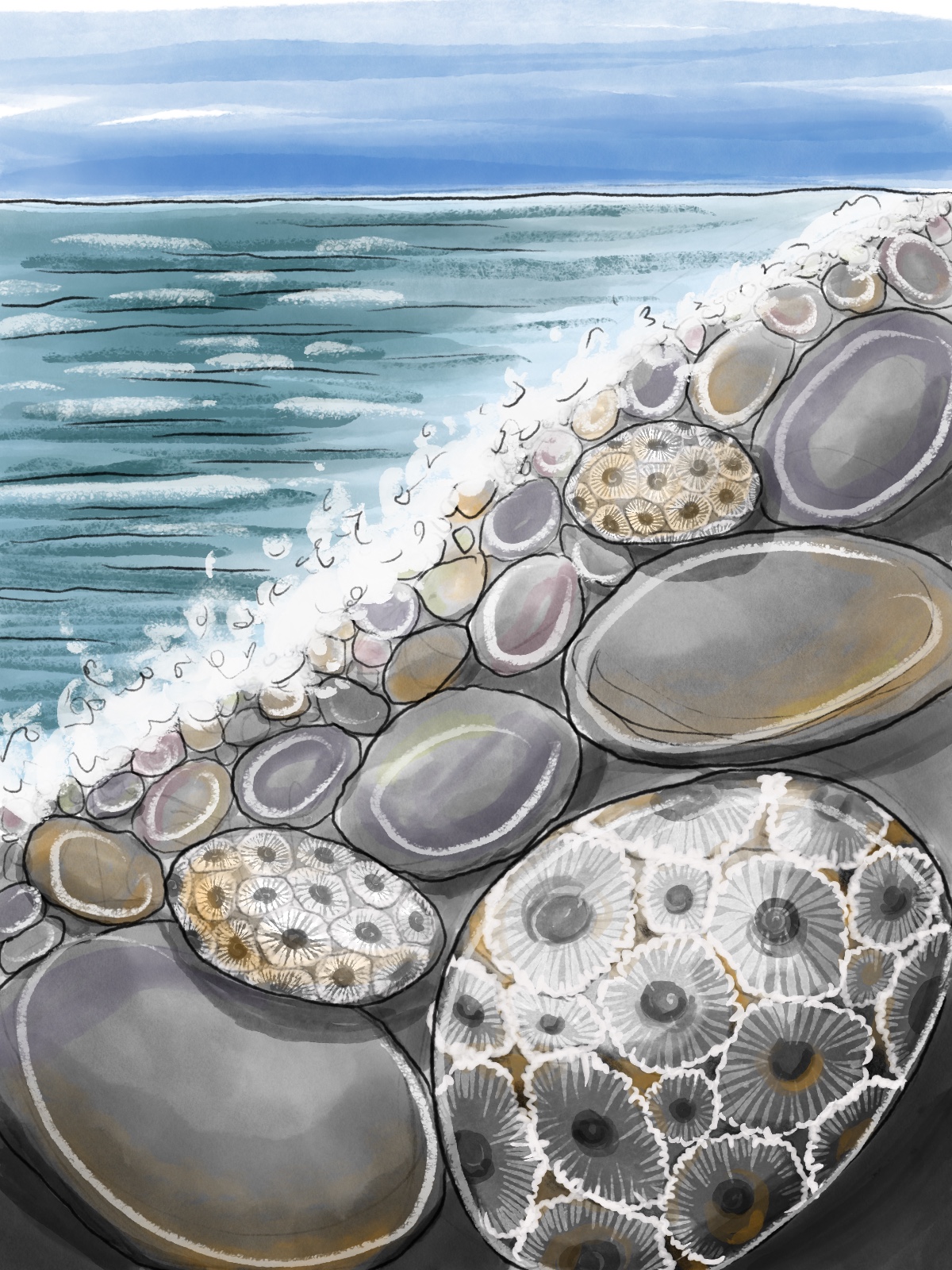
Before the world was big, before Benefit Street and Big Bend Boulevard, before Achilles tendonitis and all the awkward annual apple pickings, before I was worried about mono and mold, I had the impression that every summer would be the same. And that’s because, for a while, they were. We used to drive up into Benzie County in northern Michigan sometime during Gemini season to get some time by the lake. There was the wooden platform under the cottage we’d stay in, home to roots and rodents, a bunker of sorts. The windy bike path around the lake that led to the gift shop full of beeswax soaps and honey sticks. The caramel agate and grey Petoskey stones, freshly tumbled, their patterns like tectonic plates trying to shift around one another. The vacationing family in the next cottage over, whose kids made me a little nervous (they crushed at shuffleboard). When I first came, I avoided the other kids and their pavement games—too much pressure to make a good impression. I preferred skipping rocks and paddling out to the bobbing wooden rafts alone, lifejacket chafing at my neck. By my final visit, I’d gotten brave. The tetherball pole became my purview. It stood at a lean, barely secured under the lakefront sand. But were all those summers really the same? There was the year I came a day late, voice hoarse from the strep throat, digital thermometer and bubblegum pink antibiotics double-bagged in brown paper; another year, with strep again, this time missing out on two days in the cottage. There was the year my dad left early to go to a friend’s funeral, and my mother drove us home at 6 in the morning to get the rental car back on time. I sang loudly to keep her awake, occasionally pinching her cheeks at her request—was I allowed to sit in the front seat that young? I dipped my fingers into a crushed Ice Mountain bottle and touched my cool, wet hands to her temples as she drove through the dark. The first Michigan summer I can remember, when I was five, a golden bee stung the tip of my big toe while I sat in the sand, and I spent the rest of the day inside. It felt like such a waste. Silly me, getting a sting at nine in the morning, before I’d even gotten in the water. I wore hot pink water shoes from then on. I’d look forward to our Michigan trip all year. The state itself became my obsession, the lakefront the setting for each of my daydreams. I thought I’d find true love there by the bonfire. I looked for signs in the face of any sweatshirted teenager who passed me on the beach to see if they saw anything in me. I thought I could swim to the other side of the lake, if I tried hard enough. I didn’t know it was eight miles long. There was another family who overlapped with mine for only one summer, whose toothy twins I continually mistook for each other: Caroline and Kelly. They were nine, I was seven. We’d roast marshmallows together under the stars and try to match the constellations to the ones printed in my well-worn library book. Gemini was barely visible, but we found Ursa Major just fine. The twins rode horses back home in Kentucky. We stayed pen pals for a couple years. Their mother addressed the envelopes with loopy flourishes and big circles to dot each “i”. Their town was one of those hit hardest by the tornado last May. Now the planets have shifted positions a million times over and the shoreline is disappearing and I haven’t visited the lake in nine years. New starscapes, new summers, new lakewater levels. New families at the bonfire, new rodents’ nests under the cottage. But how would I know? So, you see, without the anticipation of the annual trip, without the routine of it, the guarantee of new faces for daydream fodder, the water’s placid constancy, it’s easy to prickle when Gemini season rolls around. No more whistling lakeside breeze for me, just the pitter-patter pattern of the rain on the cement. The tropical levels of humidity haven’t arrived just yet, but they will soon. There will be signs.

Across the Atlantic and Back

Maison Texeira
February 19, 2026

1975. Shirley dreams that she’s at her job, working behind the counter at a small bar called the Devon in the seaside town of Hartlepool, wearing a white T-shirt with a Penny Farthing bicycle on it. A handsome guy walks in with a lovely smile, brown skin, and jet black hair. They talk for a while, until she wakes from the dream. A few weeks later, Shirley sits behind the counter at the Devon, wearing the same white T-shirt, only this time she’s awake. That’s when the man of her dreams walks into the place and asks her for a drink. They talk for a while, until he and his crewmates are called back to the ship, and he leaves to set sail once again. The man of her dreams, otherwise known as Big Manny, comes back to visit Shirley occasionally. Eventually, he makes her a present: a Penny Farthing bicycle made out of nails driven into a piece of wood. She loves it, and soon enough, he comes over to stay with her and the son she’s been raising by herself. They live together, but not really; he’s away most of the time, cooking delicious meals for hungry sailors adrift on the merchant ships. When he’s back home with her, they go to the disco together, boogieing all night to Earth, Wind, & Fire, the Stylistics, and Donna Summer. They’re spectacular dancers; they can do the Bump, the Hustle, they can Rock the Boat, and everything in between. Today, Shirley is still a spectacular dancer, but she tells her grandson that nobody could dance like her husband used to. Her grandson wishes that he’d inherited some of their dancing genes. ~ 1977. Shirley and Big Manny have a child together: a chubby, white, red-haired boy whom they also name Manny, otherwise known as Little Manny. Five years later they have another, a brown-skinned girl with black hair whom they name Maria. They carve out a life in Hartlepool, with Shirley taking care of the kids and Big Manny continuing to live out at sea, coming home for one month out of every year. Hartlepool isn’t always kind to their family, being one of few mixed race families in the town. One time, a boy throws a brick at Maria’s head and calls her the N word, and Little Manny fights back by throwing several bricks at his head and beating him up. Little Manny gets into tons of scraps with other kids, but most of them are with his older brother John, who torments him — and loves him — like no one else. John can beat Little Manny up all he wants, but as soon as anyone else so much as lays a finger on his younger brother, he shows up to break that finger, as well as maybe an arm or two. Little Manny also has many girlfriends growing up, but his first true love, the one he’ll someday meet and bear a child with, is all the way across the Atlantic, in a country he’s never even heard of. ~ 1986. In the third-world metropolis of Belize City, there lives a woman named Vianney who is raising her daughter Melanie and her infant son Sergio. Melanie is a feisty young girl, running around the city with her younger cousin Camille. The city is their oyster, and yet it is also a dangerous place. This is a city where old men carry crocus bags and use them to try to catch young girls, which almost happens to Melanie and Camille one day. This is a city where watching a woman almost drown in the canal is nothing unusual, at least not to the wide, curious eyes of little Mel. And worst of all, this is a city where Tataduende, the dastardly dwarf with backwards feet and a penchant for stealing children's thumbs, is believed to roam from time to time. Melanie often conceals her thumbs within her fists when she walks about. This is a city of peril and poverty, yet Melanie only sees the wonder of it all, especially in the big, gaping eyes of the kittens she and Camille find at the corner store. They bring the kittens back to their great-grandmother Mims, who had asked them to get her some tea bags, not these adorable kittens. Mims explains that Melanie and Camille have failed to consider the fact that they are very, very poor. How are they going to feed these kittens? ~ 1989. Shirley and her family decide to move to the United States of America, on the Northeast coast of New England. That’s where most people who left Big Manny’s homeland of Cabo Verde have wound up, and it’s where his two sisters and most of his brothers call home. Little Manny, Maria, and John all enroll in school, where Little Manny is scolded for staying seated during the Pledge of Allegiance. “I don’t pledge allegiance to this country,” he says to the teacher. They do American things, like going to McDonald’s, where John tells Maria to give him all of her fries because he heard that “McDonald’s supports the Irish Republican Army.” Little Manny makes lots of friends, who come to know him as “English Manny,” and his accent makes him a catch with the girls at his school. He and his friends live on the edge, riding their dirt bikes through abandoned factories and going toe-to-toe with each other in bareknuckle street brawls. Shirley misses England dearly, and later admits to her grandson that she never wanted to move to America. When she returns to her home country for the first time in twenty years, she finds that it’s no longer the England she remembers. ~ 1989 (still). The same year Shirley and her family move from England to the Americas, Vianney and her 9-year-old daughter, Melanie, move from the Americas to England, while Sergio stays behind with his Dad. Melanie is excited, her little Caribbean mind imagines England as the land of fairytales and royalty. When she gets there, there aren’t any fairies, and she doesn’t meet any princes or princesses, but she does find things like clean sidewalks, dentists, rubbish bins, and street sweepers — luxuries that didn’t exist in her home country of Belize. They’ve moved here because her mother has married an English army man, who hits her and calls her names. He is sent to Iraq for months at a time, and Vianney and Melanie savor these months without him. Vianney begins to know England as home, much more so than Belize, which is slowly becoming a much-desired tourist destination for its beautiful sandy cayes. While talking to her grandson many years later, she laments that the Belize she knew as a child is gone, and that the Belize where snotty American tourists spend their winter holidays is not the Belize she wants to return to. ~ 1997. Little Manny, who is no longer little anymore, travels back to England frequently, attending raves where DJs play techno, trance, and house music as a pulsating sea of people dance. At one of these raves, Manny lays eyes upon the most beautiful girl he’s ever seen. Manny approaches the girl and asks her name, which she says is Melanie. They strike up a conversation, and he asks her if she’s seeing someone. She says she’s seeing a guy named Danny… who just so happens to be Little Manny’s best friend. Nevertheless, they form a friendship that blossoms over the years. Manny spends his early 20s living many lives. He lives one life as DJ Synista, renowned in the Providence nightclub scene for spinning techno records that transform empty Brown University halls into living, breathing dancefloors, where college students boogie their cares away. He lives another life in Tenerife, a married life, one that somehow survives for some time after his pet ferrets devour all of his wife Eleanor’s gerbils but still ends in an unceremonious divorce. Eventually, Big Manny’s son moves back to Rhode Island, where he continues his usual escapades with beautiful women — all of whom he completely drops after convincing Melanie to come fly back across the Atlantic to the States, where she’ll live with him. In the meantime, Big Manny takes up work in the restaurant business. He becomes the head chef at Cantina di Marco, a cozy Italian restaurant in Cumberland, RI, of which he will soon become the sole proprietor. He’s finally found a home for his five-star cooking after many years traversing the globe on merchant ships. Cantina di Marco becomes a second home for Big Manny and his family, a second home populated by strangers who come through its double doors to dine, drink, and mingle. These strangers don’t see the inner workings of Big Manny’s crowded kitchen, where chefs toil over stoves and chopping boards, but the savoury flavor of his signature prime rib or his alfredo linguini speaks volumes to the culinary brilliance hiding behind the kitchen’s swinging doors. ~ 2025. Manny and Melanie are no longer together, but they have an unbreakable bond that’s lasted twenty years and looks a bit like both of them, with his mother’s hazel eyes and his father’s round head. Their son, Maison, was once a wide-eyed little boy with an afro, sitting on his father’s knee as Manny recounts the moment he met his first true love. Now, he’s a young adult, carrying the stories of his parents and their parents with him wherever he goes. His grandad, Big Manny, lives on in his memories. He remembers Cantina di Marco as though it never closed down, remembers sitting in a trolley with a big grin on his face as Big Manny pushed him around the parking lot, remembers chilling at home with Big Manny as they munched on bananas and pretended to be monkeys. As a young adult, Maison will one day find himself writing a creative nonfiction piece about how his family came to be. He will write this piece in his now-retired grandmother Vianney’s back garden as she reminisces in the kitchen with her daughter, laughing about Melanie’s escapades in York. He will write this piece while sitting next to his mother Melanie and asking her what her life in Belize was like. He will write this after having spent several weeks with his father Manny, who’s back in England after all these years, now living happily with his second love Chantelle. He will write this for his family, a family which is, quite literally, beyond the wildest dreams of a young English girl working at a bar in the quiet seaside town of Hartlepool.

See More

Our Mission

Our Mission

Sole Magazine was created to provide the Brown community with entertaining and informative feature writing about true events, people, and experiences but without the stylistic restrictions of hard journalism. We aim to tell interesting stories in interesting ways, using techniques of characterization, description, and theme, while experimenting with structure and tone to produce creatively crafted narratives.

Meet Our Team
SAO Disclaimer

The content of UCS/GSC recognized student organization websites is generated independently from Brown University. The statements, views, opinions, and information contained on the site are personal to those of the authors and student organization and do not necessarily reflect those of Brown University. The content on the site is not reviewed, approved, or endorsed by Brown University or its faculty or staff.